Leia’s Long Look: Delving into Calida Rawles’ ‘Away with the Tides’
Leia’s Long Look is a new monthly column providing focused looks at individual artworks, prompting slow looking and deeper reflections. This month, Leia examines two of Calida Rawles’ paintings in her solo exhibition “Away with the Tides,” on view through September 5 at Spelman College Museum of Fine Art.
In the peak of summer, everyone is drawn to water. Whether pools, lakes, oceans, rivers, streams, hoses, sprinklers or rain, we seek out water to ameliorate the stifling summer heat. Walking through Calida Rawles’s solo exhibition Away with the Tides, awash with depictions of water in shades of cerulean, robin’s egg and cobalt, is a refreshing addition to the list.
On view at the Spelman College Museum of Fine Art through September 5, the exhibition portrays water as a substance signifying both healing and racial exclusion — for example, reprieve from heat and segregated swimming pools. In Rawles’ compositions, clothed Black figures are adrift, submerged to varying degrees in unidentifiable bodies of water. Seen from a bird’s-eye perspective, the figures dissolve in the turbulence of refracted light. Shown this way, Rawles argues healing does not always come from reconstitution — rather it can arise from a release, a depersonalization of the pain.
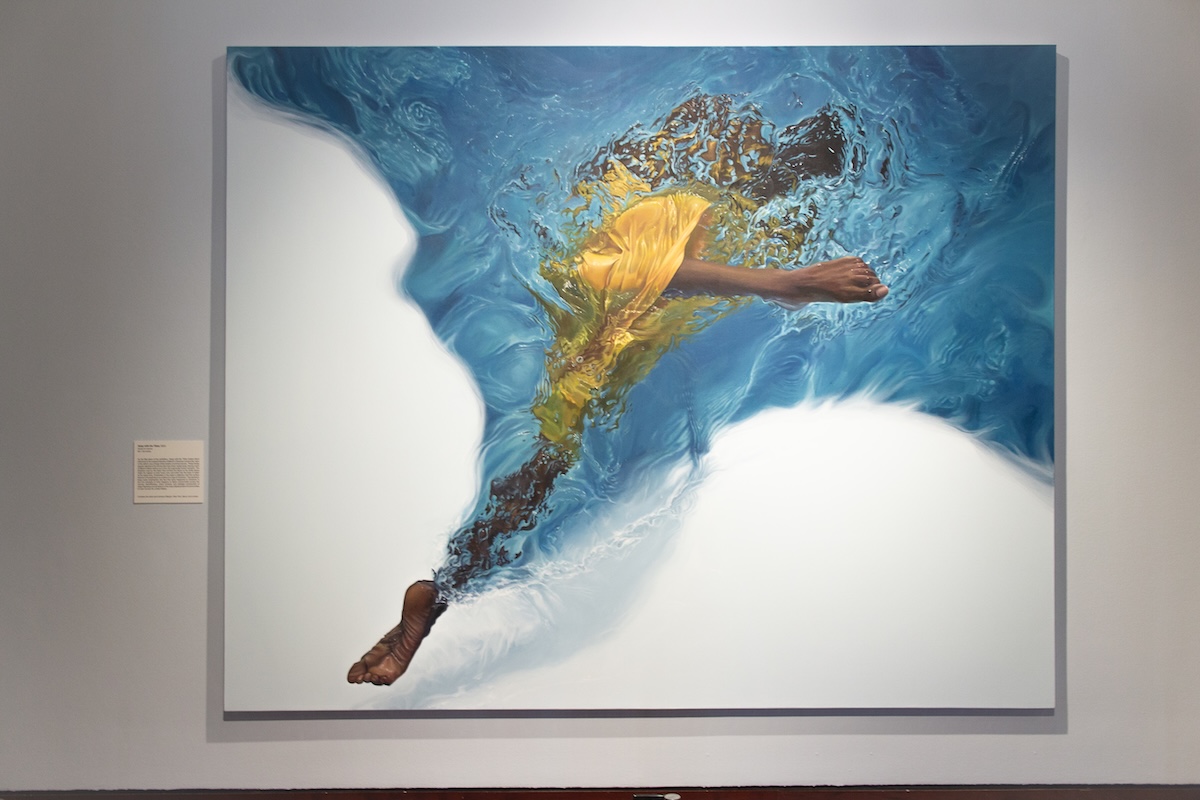
The eponymous artwork of the exhibition opposes the entryway. Monumental in scale, the acrylic on canvas painting renders a wave of blue water diving toward the lower left corner across a white ground. Within the wave is an inverted figure enveloped in loose-fitting, dandelion-yellow fabric. Only the figures’ two feet remain above the surface. Their right spearheads the wave crashing toward the lower corner, their other bends to point directly at the right edge. Where submerged, the figure is indiscernible through the visual noise of roiling water.

The wall label for the artwork states the painting is a reference to Miami’s Overtown community — a once-thriving Black neighborhood that was segregated by design, broken apart by the construction of Interstate 95 in the 1960s and further fragmented by gentrification and development. The figure is thus fractured. While apparent the two feet are connected to a body somewhere, it is impossible to determine its uniqueness, identity or personality. Similarly, Overtown was dissected, leaving the once precious whole as a smattering of artifacts and indeterminate recollections. Here, water is the disruptor: a barrier through which physical integrity cannot persist. Healing, then, is not identification of the individual. It is breaking across the whiteness, flooding the expanse and disrupting the flat ground.
Water, however, is not just a disruptor in the exhibition. Immediately adjacent to Away with the Tides (2024) hangs the comparatively much smaller painting Release What I Will Not Give (2024). This time, water completely covers the ground, its tumult creating swaths in the composition that are visually indistinct from nonrepresentational, abstract painting. A feminine figure, floating on their back, sidles up to the left edge, their body hovering just below the surface. The water must not be deep as the center of the composition shows the person’s silhouette. The figure’s expression sets the tone: eyes closed; mouth slightly agape; facial muscles completely relaxed. This person is not subsumed by the torrent seen in Away with the Tides; rather they are comforted by it.
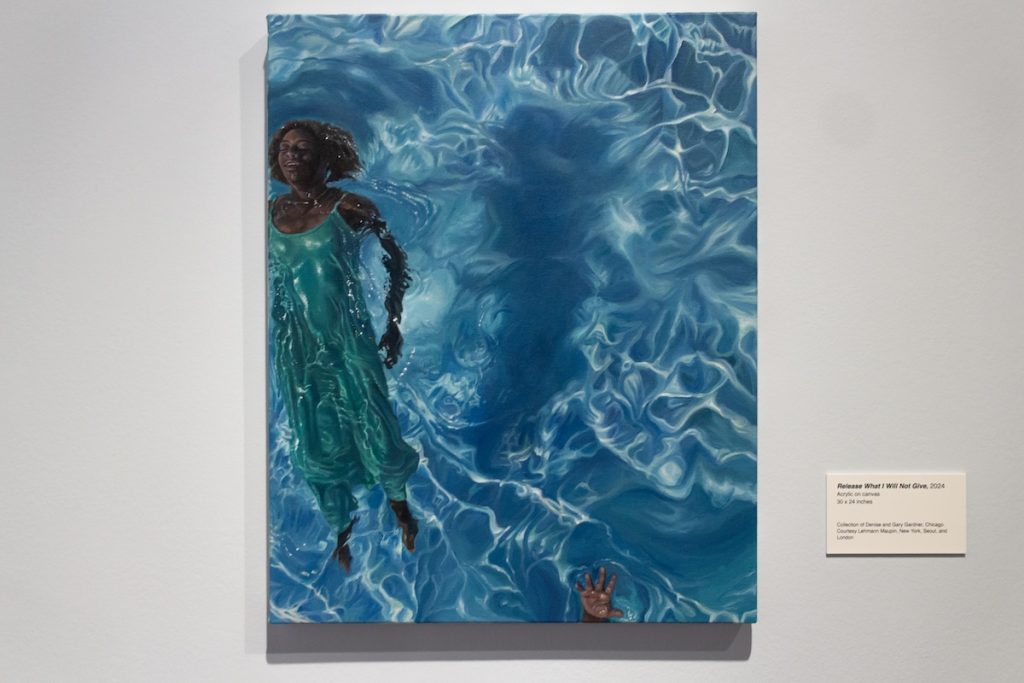
Although visually distinct in a nest of swirling lines, the figure is not the subject of the composition. Drifting beyond the edge of the painting, the figure is departing. Their silhouette holds the visual center. It is a portrait not of a person but of a shadow. Here, water leads to dissolution. Healing is not the recentering of an individual but its absorption into a larger body. This is not an altogether pacifying moment though. Peeking up from the bottom edge is an outstretched hand, reaching toward the viewer as if seeking help. Transference of individual pain does not eliminate it, only displaces it, as this reaching hand reminds us.
Rawles does not create solace or resolution — more so a relaxation into the wrought destruction. Overtown is no longer whole, but Rawles shows that being swept away in the tides, political or otherwise, need not isolate. Instead, it can be transfigured into a union between people, at once comforting and full of memory.

::

Leia Genis is a trans artist and writer currently based in Atlanta. Her writing has been published in Hyperallergic, Frieze, Burnaway, Art Papers and Number: Inc. magazine. Genis is a graduate of the Savannah College of Art and Design and is also an avid cyclist with a competition history at the national level.
STAY UP TO DATE ON ALL THINGS ArtsATL
Subscribe to our free weekly e-newsletter.

PLEASE SUPPORT ARTSATL
Your Gift Sustains the Coverage You Count On!
Related Posts