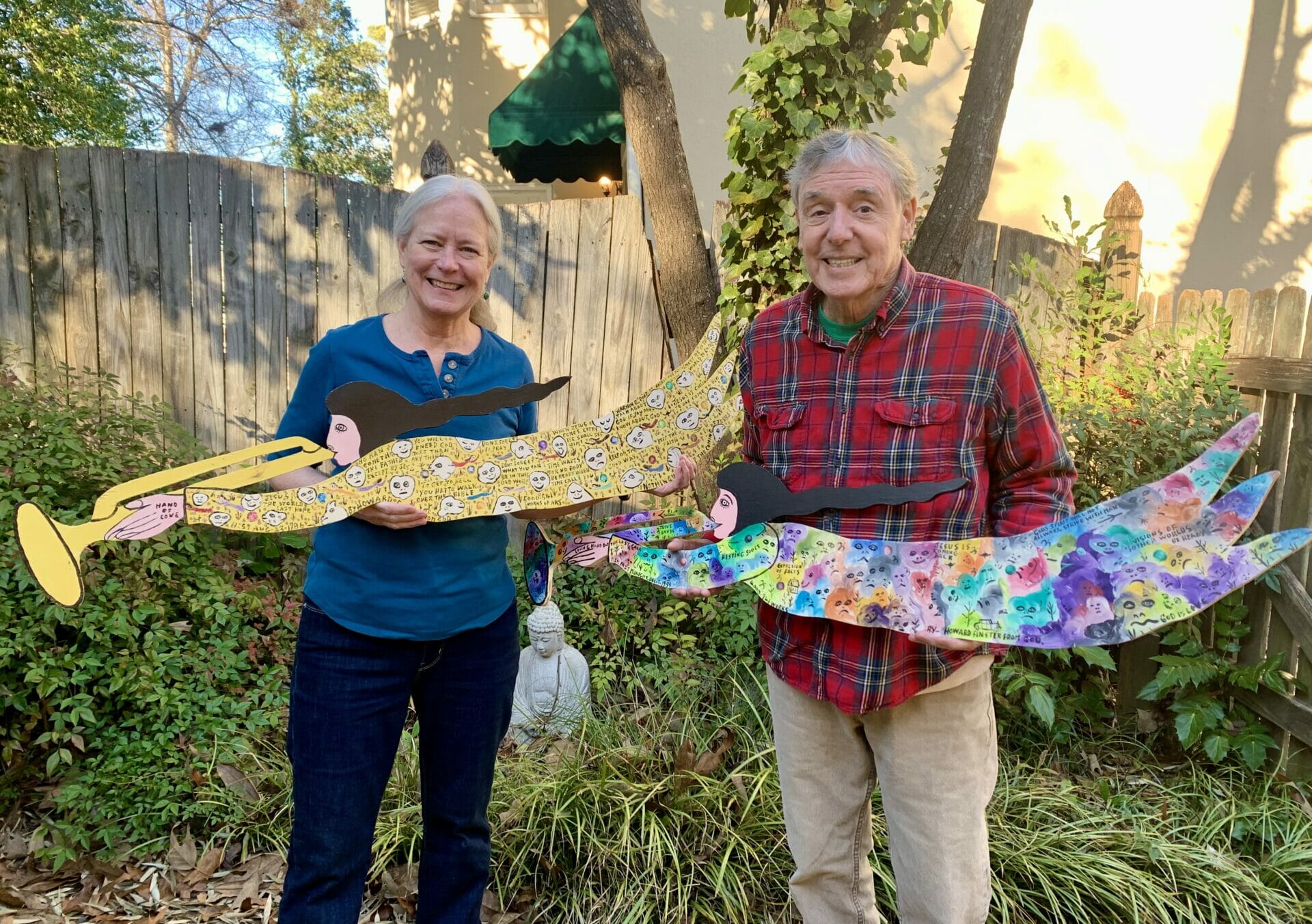
Howard Finster exhibit from friends with a front-row seat for the folk artist’s rise
Becoming close friends with Howard Finster, who emerged from Northwest Georgia as a major figure in American folk art during the late 20th century, was like watching a free-flowing fountain of creativity for Rick Berman and Jennie Ashcraft Berman.
The couple, who represented Finster in their variously named Atlanta galleries from 1984 to 1997, could hardly look away for fear of missing something consequential. Plus, Finster (1916-2001), while small in stature, was a character and a half — a rural preacher who, around retirement age, turned to art to try to save souls in a world that he believed was no longer spinning right.
The prolific artist is credited with creating an astounding 46,991 numbered works, not counting Paradise Garden, his 4-acre Summerville roadside attraction/folk-art environment that survives him.
“Everything he did blew my mind,” Rick recalls on one recent sunny winter afternoon, relaxing in the couple’s art-filled Candler Park bungalow. “I couldn’t get enough of him. He was so much fun. We just loved him.”
Some 20 Finster works from the Bermans’ nest have migrated to Callanwolde Arts Center, where the exhibition Howard Finster: A Feeling Come Over Me opens on Wednesday for a run through January 27. Reservations are encouraged.
The intimate show speaks to the close friendship, partnership and close-up view that the couple enjoyed with the creative force that was Finster.
Rick recalls flying to New York with the artist in 1989 for the opening of an exhibition that would become one in a series of career breakthroughs: The Road to Heaven Is Paved by Good Works, a 100-piece survey presented by the American Folk Art Museum.
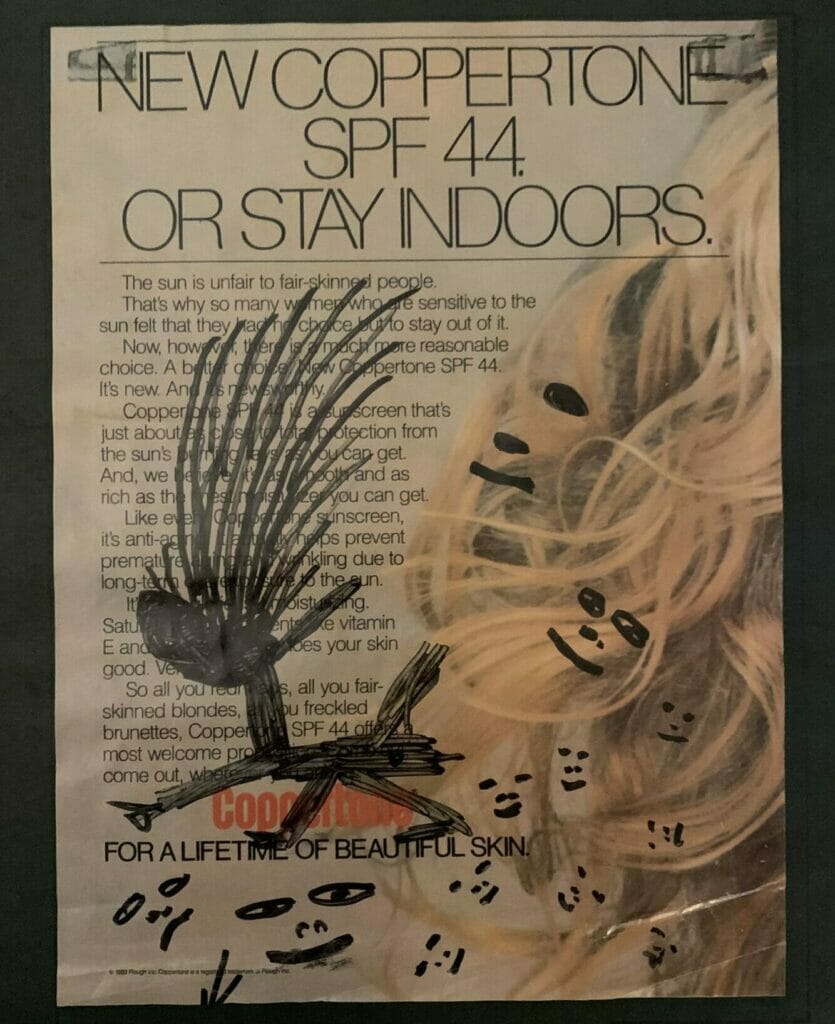
To help pass the time, Rick grabbed some free magazines and gave one to his friend, suggesting he draw on a page. Finster dug out Sharpie markers from his carry-on bag and went to town. “He kept going and going, and filled the magazine; must have been 30 or 40 drawings in there,” Rick says. “Howie didn’t have to think. It was just a flow, a stream of consciousness.”
The magazine drawing shown here is included in the Callanwolde Gallery show. Below, Rick shares backstories about other Finster works, most of them included in the exhibit:
::
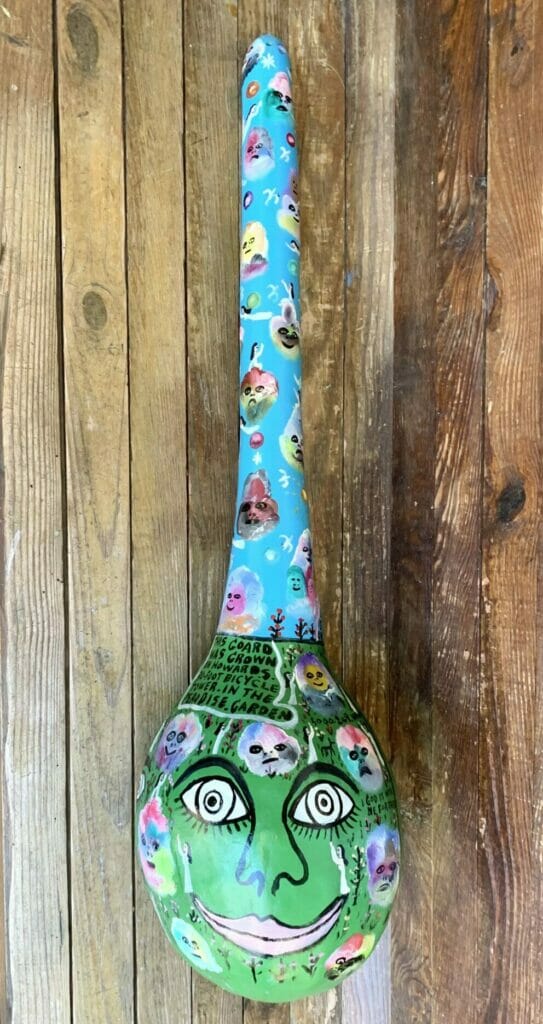
Finster painted a big cheerful face on the front of this gourd and added one of his trademark promotional passages. “This goard [sic] was grown on Howard’s 30-foot bicycle tower in the Paradise Garden,” the artist wrote, referring to his landmark sculpture that appeared in R.E.M.’s first video, Radio Free Europe, in 1983.
But while some of his signature cloud faces are smiling as they float around the work, others wear frowns. It’s an indication of the sad tale that Finster inscribed on back, in his usual capital-letters scrawl, about a New York lawyer who called him past midnight one night in 1986, contemplating suicide.
“A man who kills his self is a worser murder [sic] than killing someone else,” wrote Finster, clearly fretting that the sanctity of life would not be respected. “He at least would have a chance.”
Rick assumes that Howard saved a life that night.
“Howard had that serious part of him where he was really trying to serve,” the gallerist says, “trying to help people in a million different ways.”
::
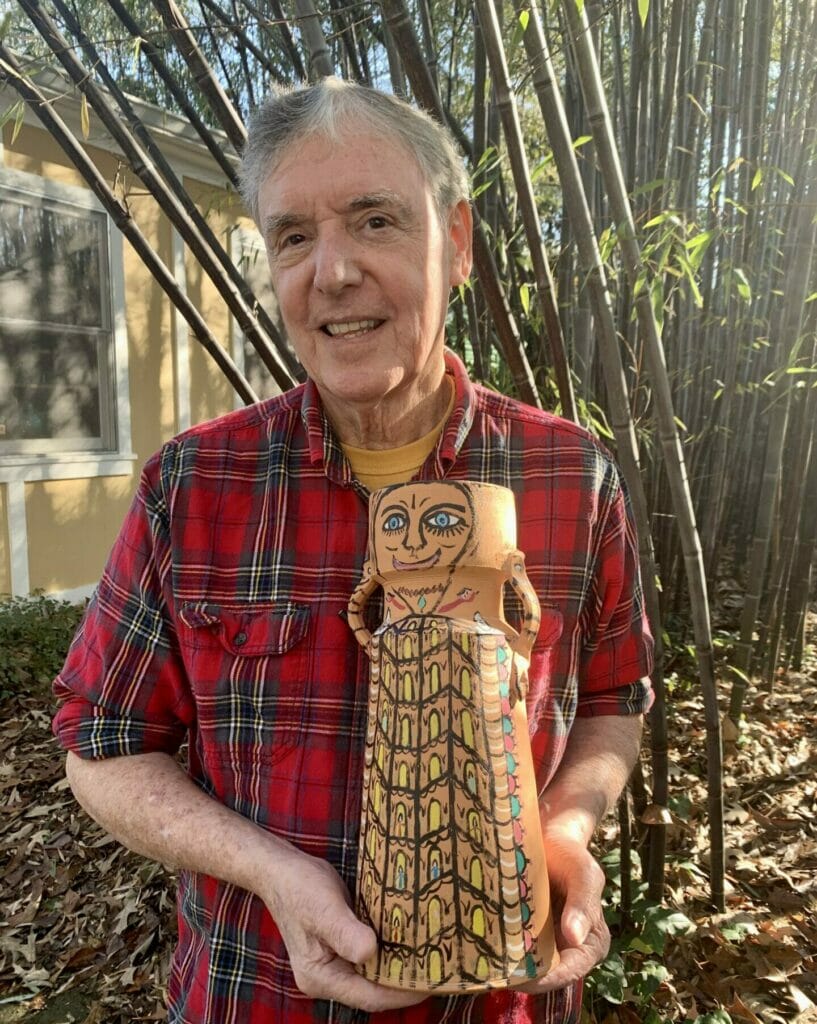
Finster was known to paint on just about every kind of thing — found wooden boards, empty wine jugs, shoes, plastic soda bottles, ceramic tea services, you name it. Heading to Paradise Garden one day in 1986, Rick, a potter like his wife Jennie, grabbed this unglazed vessel that he had thrown.
Finster quickly got to decorating it, painting the figure and an angel-inhabited “mansion” (as Finster called these recurring structures) on the front. On the back, he improvised this poem (punctuation added for clarity): “I feel so bad when I want to be glad, but it’s not for me to have my way. But Rick is here, I have no fear, this is getting clear. My sun is shining out, I am now moving about. I think I can make it after all. I am 70 years old. No silver or gold. But I own my soul, so that’s good anough [sic] for me.”
A Feeling Come Over Me extends the Bermans’ long-standing presence at Callanwolde, where Rick founded and directed the highly regarded ceramics program from 1973 to 1980. This winter, he is teaching a ceramics art history class, and Jennie is teaching a pottery class, at the arts center.
::
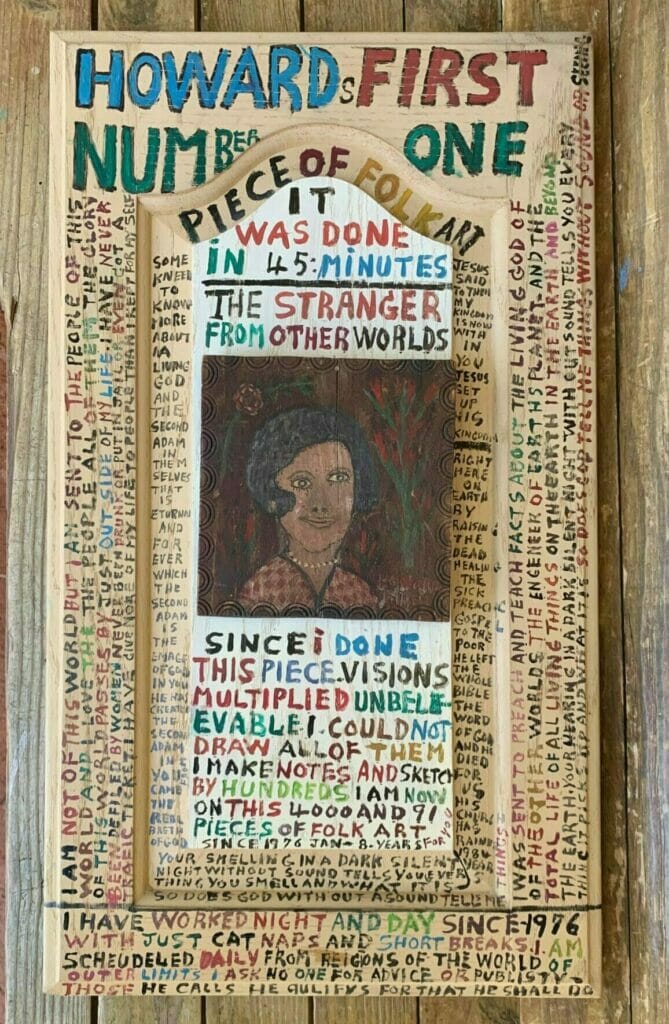
Rick says the dark portrait at the center of this wooden construction may be Finster’s oldest painting, possibly dating to the late 1950s or early 1960s. The piece was done even before Finster began his well-known process of assigning numbers and dates to his creations. When he later affixed the painting to the cabinet door above, he proclaimed in colorful lettering that the portrait was “Howard’s First, Number One” painting.
With the artist having been unpredictable in terms of his stories and claims, it’s possible that there may be more than one “first painting” somewhere in the world. In any case, Rick believes this portrait is indeed very early and thinks it is of Finster’s Number One in life, his wife Pauline.
::
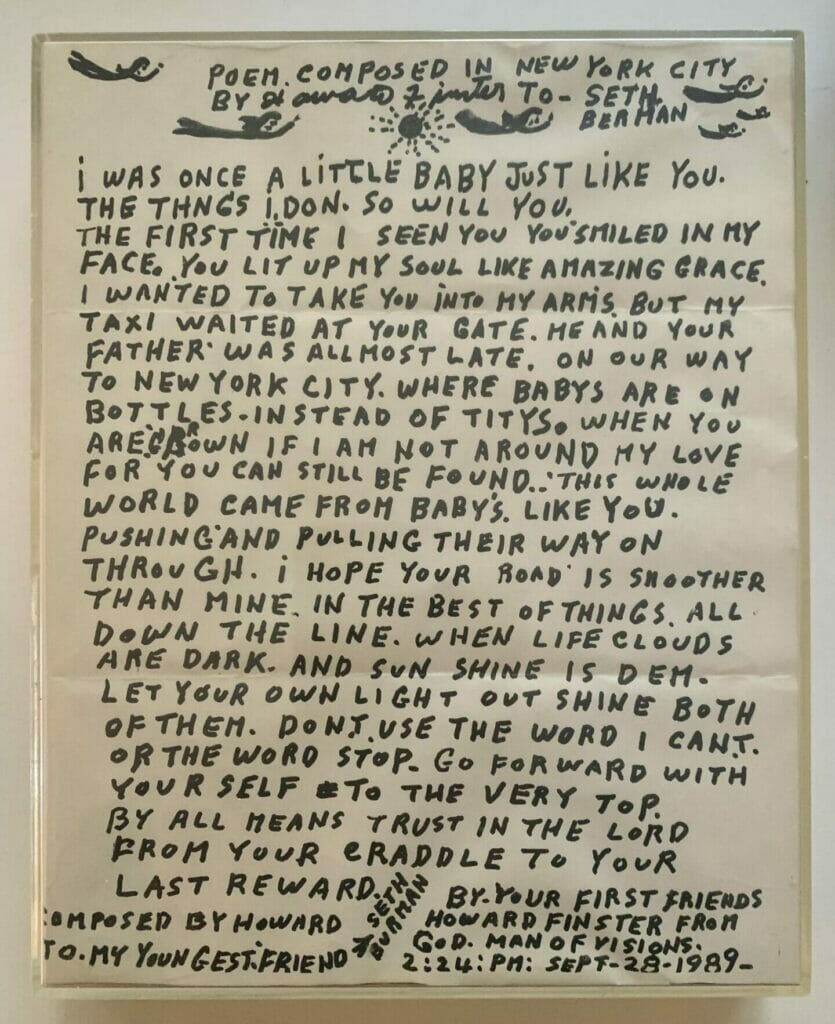
Finster met the Bermans’ infant son, Seth, right before Rick accompanied Howard to New York in 1989 so that the artist could appear at The Road to Heaven Is Paved by Good Works. Finster was smitten with the little fellow, peeling off a $100 bill from his wallet as a gift.
After he and Rick checked into their shared Big Apple hotel room, the artist composed a poem to Seth, now 33, off the top of his head. It includes the sweet line, “The first time I seen you, you smiled in my face. You lit up my soul like amazing grace.”
::
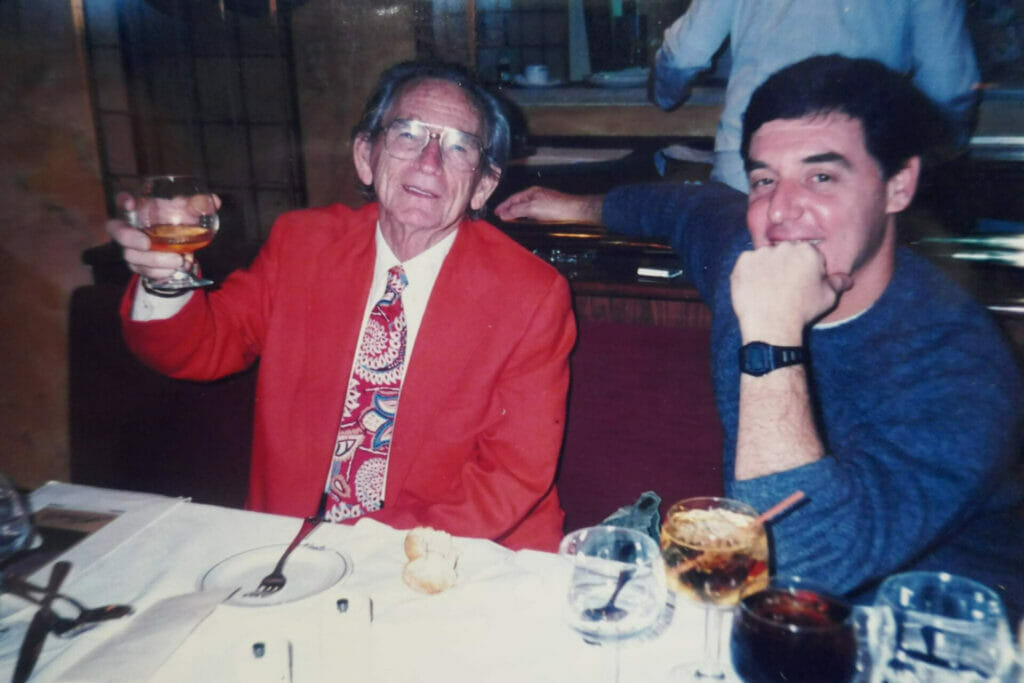
Known as a teetotaler, Finster enjoyed a rare glass of scotch at a reception where the artist was feted by American Folk Art Museum leaders and others involved in his sprawling exhibit before it opened at the Paine Webber tower gallery. Reveling in the spotlight, Finster even ordered oysters, which Rick (right) figures was the first time he had sampled them.
::
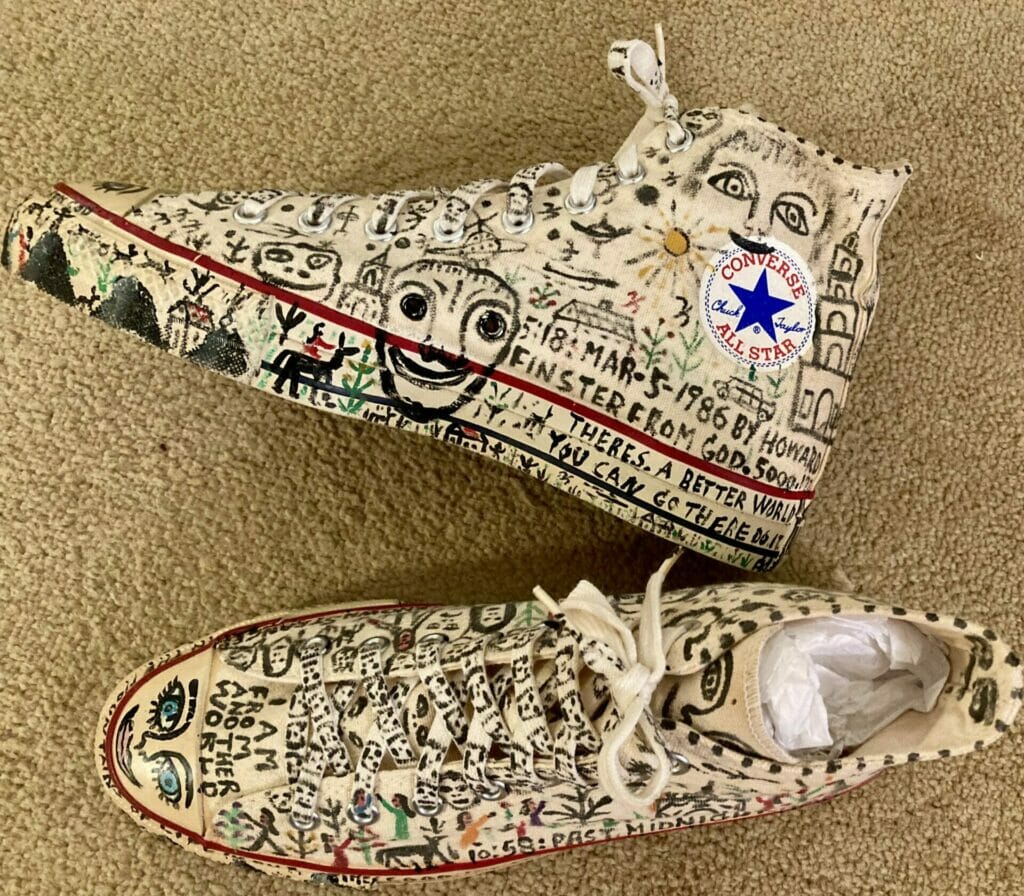
Rick long has been a fan of Converse All Stars and took a new pair of the kicks to Finster to paint in 1986. The gallery owner was so pleased with the way they turned out, he believed that there was big sales potential in mass-marketing them. So he contacted Converse and shipped them to its headquarters in Boston for consideration.
“But they said no and sent them back,” Rick says. “I do have permission from Howie to do whatever I would like with them, so it is possible to try again someday.”
::
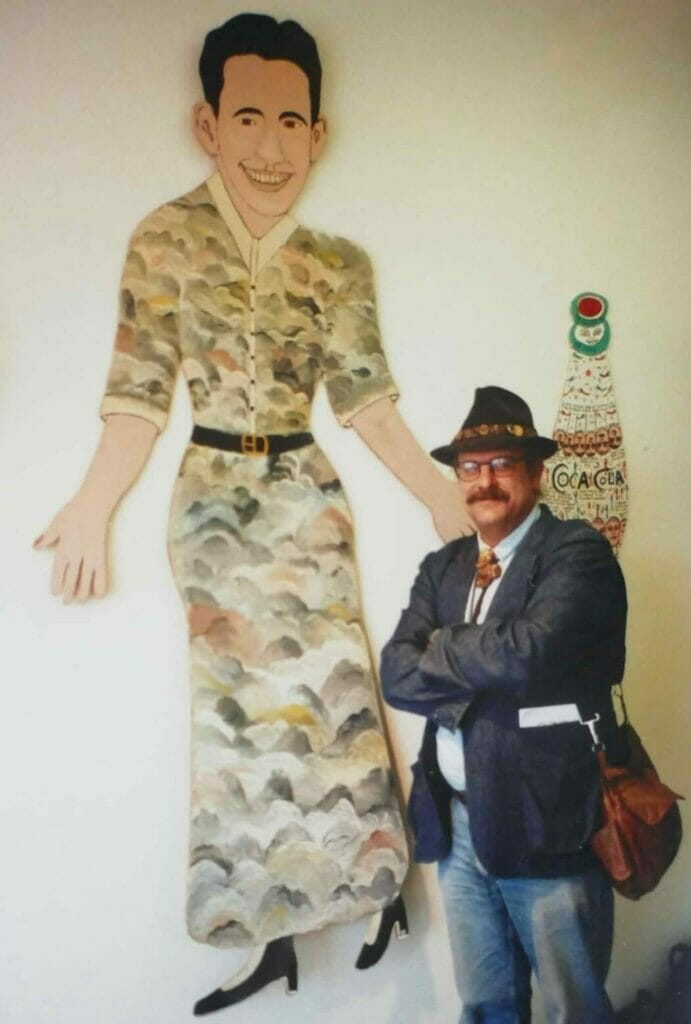
As art dealers, the Bermans couldn’t keep every Finster piece they loved, but this bigger-than-life-size self-portrait of the artist in a dress is one they wish hadn’t got away.
Rick was startled when he first saw it. “I asked Howard, ‘What is this about?’ I had no idea! And, of course, he always had an answer. He said, ‘You know, it’s so hot in the summer in [the artist’s native state of] Alabama that when farmers went out into the fields on tractors, they would wear a dress because there was so much better air circulation.’
“That’s oral history right there!” Rick exclaims.
As for those high heels, he has no idea.
In this undated photo, J.F. Turner, author of the 1989 biography Howard Finster, Man of Visions: The Life and Work of a Self-Taught Artist, is shown with the painted cutout in the Berman Gallery in Buckhead.
::
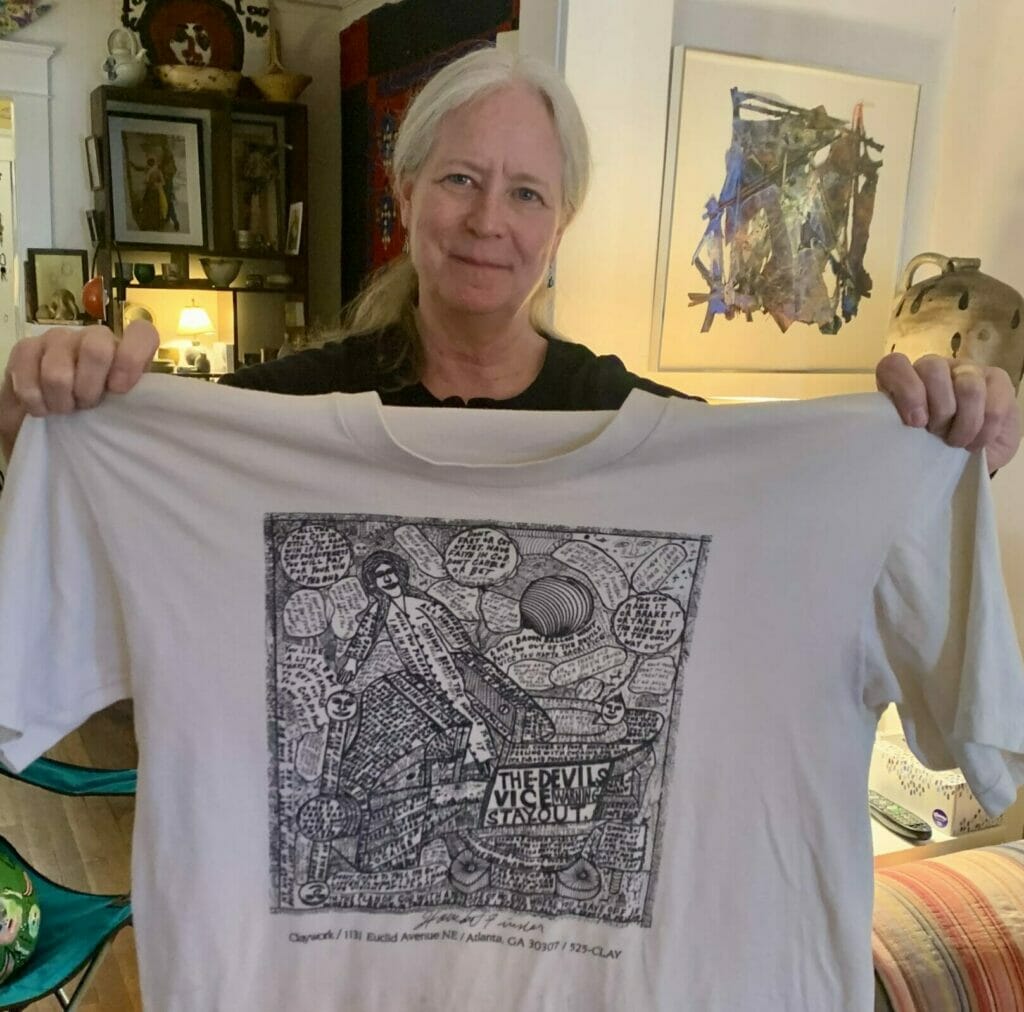
The Bermans’ gallery Claywork (which later went by Claywork Gallery and Berman Gallery) sold hundreds of T-shirts featuring a graphic of Finster’s Devil’s Vice, shown off here by Jennie Ashcraft Berman. The artist drew or painted the image, in which he cleverly employed a carpenter’s vise as a metaphor for the way drugs and alcohol tighten their grip on the addicted, countless times.
::
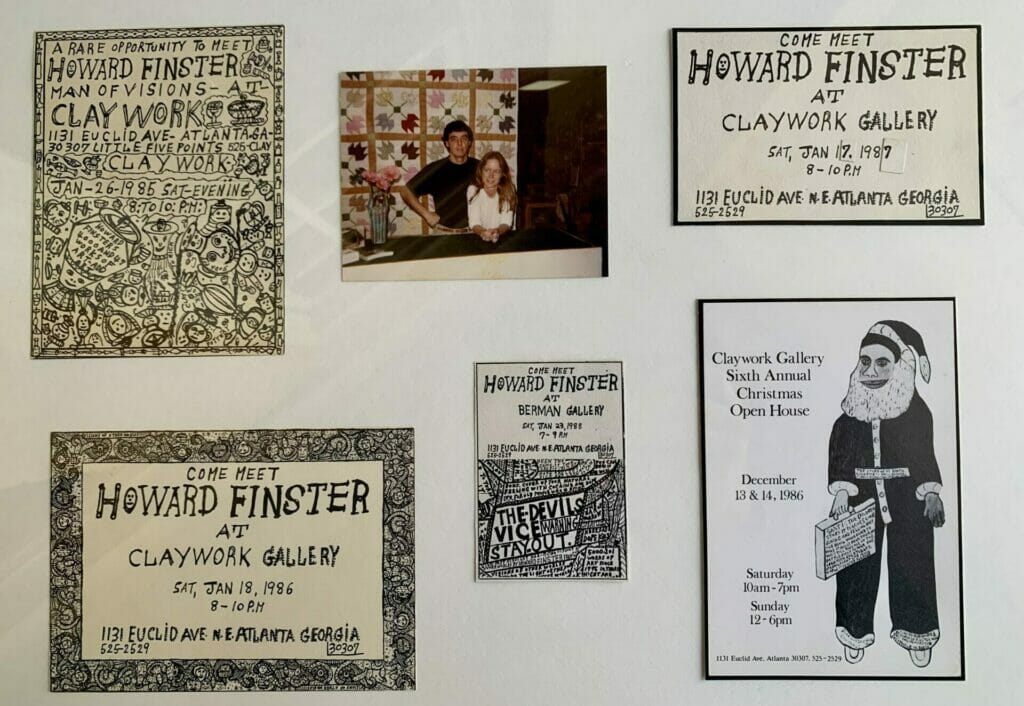
Over the years, the Bermans (shown top center in their Little Five Points space) mounted four exhibitions of Finster’s work. The couple smartly had the guest of honor provide artwork they could use for their invitation designs. Jennie framed them for the first time for the Callanwolde exhibit, appreciating them in a different light — as part of history, the gallery’s and Finster’s.
::
Rick grew up in Wilmington, N.C., and is familiar with how everything stops for funeral processions in the small-town South.
Still, he was stunned when Finster died in 2001 and “the entire town of Summerville came out to the street and followed the hearse. Everywhere you looked, there were people out in front of their houses, paying their respects to Howard going by. Real old-school stuff. Incredible.”
The scene at the overflowing Erwin-Petitt Funeral Home also moved the folk artist’s friend. “It was like a billion flowers,” Rick says. “I mean, it looked like Elvis’ funeral. I’ve never seen so many flowers before.”
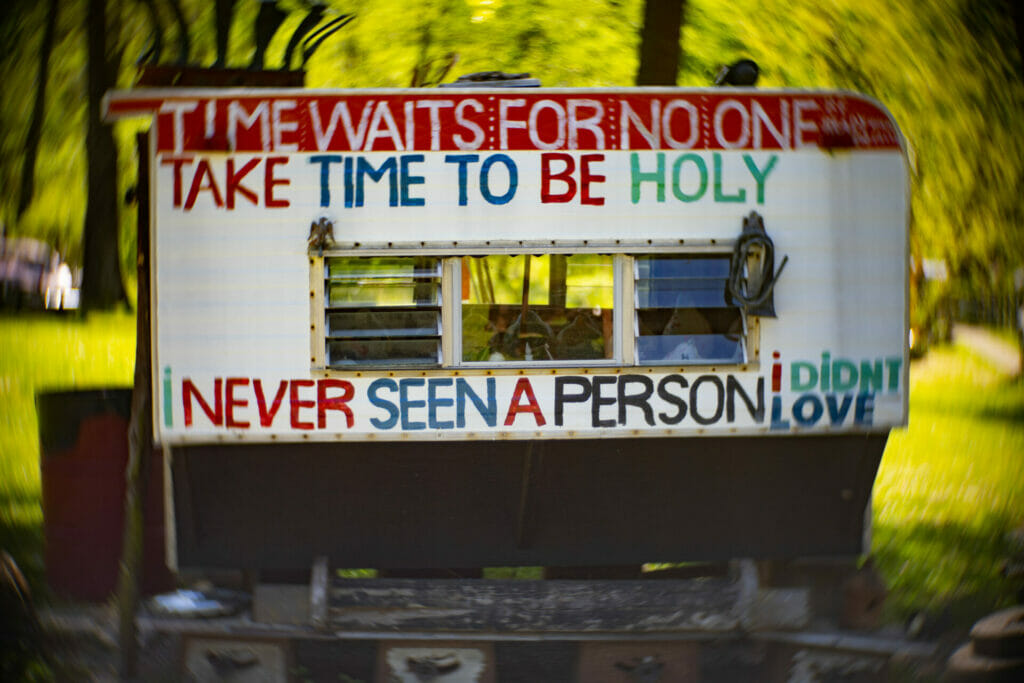
Throughout his art career, Finster painted endless messages encouraging people to get right with God while still on this earth, including on this trailer at Paradise Garden.
The Bermans have no doubt that Howard is with the angels now.
::
Howard Pousner had a 35-year Atlanta Journal-Constitution reporting and editing career and is a former ArtsATL Senior Editor. He now works as a freelance journalist, contributing to publications such as ArtsATL and the AJC, and handles media relations and social media for clients including Breman Jewish Heritage Museum, Slotin Auction and Main Street Gallery. A Paradise Garden Foundation board member, he curates its annual Finster Fest artist market.
STAY UP TO DATE ON ALL THINGS ArtsATL
Subscribe to our free weekly e-newsletter.

PLEASE SUPPORT ARTSATL
Your Gift Sustains the Coverage You Count On!
Related Posts