Dance Canvas nurtures choreographic talent, brings it to the stage this weekend
When Taylor Swift swooped into Atlanta last year, her Swifties probably didn’t think about the show’s choreographer, Mandy Moore, the same person who created those gorgeous dances in the 2016 movie La La Land. Recent movies, too, are full of work by talented choreographers: Fatima Robinson drew on African-American social dance in The Color Purple, Jennifer White gave audiences stupendous silliness in her Barbie dance sequences and Justin Peck, who did the choreography for Steven Spielberg’s West Side Story in 2021, paid tribute to Jerome Robbins again in last year’s Maestro.
Not every budding choreographer aspires to work in commercial film; there’s the world of ballet, contemporary dance, tap and more on the concert stage. But whatever the medium, a career in choreography requires a broad spectrum of talent and skill: good dance training, a rich imagination, perseverance and, whenever possible, a mentor to nurture and direct a person’s passion for the artform.

In Atlanta, that mentor is Dance Canvas, a nonprofit founded in 2008 by former dancer Angela Harris.
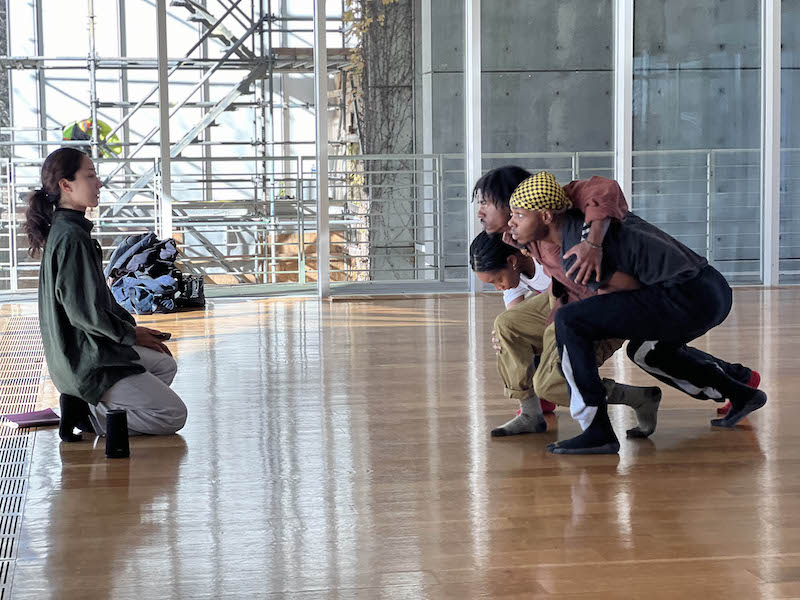
For 15 years, the organization’s Choreographer Career Development Initiative has given emerging dance makers an opportunity to hone their craft, learn about the business of dance and showcase a work in the annual Dance Canvas Performance Series. A companion program, Dance Canvas: On Film, launched in 2022.
This year’s graduates will present work at the Ferst Center for the Arts March 21 through March 23. Five dance filmmakers will be represented in Dance Canvas on Film on March 21, and seven choreographers will show their works on the Ferst stage March 22 and 23.
The six-month Career Development Initiative, one of several Dance Canvas programs, is similar to a residency and culminates with these performances every spring, when participants present the dance work they have created.
The 2023-24 Initiative started several months ago with an application process. Most of the 30 applicants are based in Atlanta, some are from out of state and two are from international locales: Scotland and Panama. All of them were assessed by a five-person panel that included Harris and Dana Woodruff (a professor of dance at Kennesaw State University) and one person from outside the dance community.
The panel based its decisions on several criteria, among them artistry, originality, technical proficiency and “spark.” The panelists also think ahead to the Dance Canvas performances. “We look at who’s the best,” Harris says, “but we also have to curate a show. We want to ensure that we’re showcasing a diverse range of talent.”
This year’s participants are from a variety of dance backgrounds, among them hip-hop, ballet, contemporary and street dance. One describes herself as “queer, disabled and neurodivergent.”
The CCDI program gives the artists resources such as studio space and access to an artistic adviser, lighting designer, professional photographer, costuming and marketing assistance and more. There are a couple of small fees involved, but most of the resources are free for the participants. Some of the support Dance Canvas receives is cash-based; some is in the form of subsidized services. Harris makes sure all the dancers who perform in the chosen works are paid.
The program also arranges for participants to lead choreography workshops at Spelman College, Emory University or Kennesaw State University. It’s the kind of pipeline that can lead to teaching jobs, says Harris.

Over the years, the program has turned away many talented applicants because they were “too experienced for our platform. We are here to support artists who still need to get their work seen,” Harris says.
Of those who will present on the Ferst stage this month, four live in Atlanta and one each live and work in Miami, New Jersey and Washington, D.C.
“We try to find people who are on a career track with their choreography but need the resources” and who would benefit from getting their work seen in cities other than their own, Harris says. “Having a new arts community is really valuable for them.”
CCDI is part of Dance Canvas’ overall mission to increase awareness of professional dance in Atlanta. It also helps movement artists gain experience in both the craft and business of the art form and potentially find paying jobs in Atlanta or elsewhere.
Dance Canvas has premiered new works by 148 emerging professional choreographers since 2008. Many of its alumni have gone on to successful careers. For instance, Juel D. Lane, a 2010 graduate, dances with New York-based Camille A. Brown & Dancers and is executive artistic associate of the Black Acting Methods Studio. He has choreographed for Ailey II and in 2012 was one of the first Black choreographers commissioned by Atlanta Ballet to create a new piece for the company.
Not all the alumni become professional choreographers. Adam W. McKinney (2017) was recently named artistic director of Pittsburgh Ballet Theatre; Simone Stevens (2016) joined Hubbard Street Dance Chicago as a dancer in 2021; and Apollo Levine (2010) was hired to portray Quincy Jones in MJ the Musical on Broadway.
Britt Whitmoyer Fishel (2015, 2018) teaches screendance at Drexel University in Philadelphia. She gives back to Dance Canvas by serving as an adviser to the Dance Canvas: On Film participants.
Dancer-choreographer Catherine Messina (2020) has created a dual-city dance initiative presenting festivals both in New York, where she now lives, and Atlanta, her former home.
“People know us in D.C. and New York and elsewhere because of the choreographers who have gone through our program.,” Harris says. “The Atlanta dance ecosystem grows when our talent pool is nurtured locally, regionally and nationally.”
In many ways, Harris is the Atlanta dance community’s den mother. “I think our dance treasures here in Atlanta are underpaid and undersupported both here and nationally,” she says, and she works tirelessly to change that, in large part by developing strong partnerships with dance studios, university dance departments and dance-related organizations that contribute in kind to Dance Canvas programs.
“This is what small organizations have to do in lieu of funding/monetary resources,” she wrote in an email. “We grow as a dance community when we work together.”
::
Gillian Anne Renault is ArtsATL’s Senior Editor for Music and Dance and has been an ArtsATL contributor since 2012. She covered dance for the Los Angeles Daily News, Herald Examiner and Ballet News and on radio stations such as KCRW, the NPR affiliate in Santa Monica, California. Many years ago, she was awarded an NEA Fellowship to attend American Dance Festival’s Dance Criticism program.
STAY UP TO DATE ON ALL THINGS ArtsATL
Subscribe to our free weekly e-newsletter.

PLEASE SUPPORT ARTSATL
Your Gift Sustains the Coverage You Count On!
Related Posts