Atlanta Symphony delivers a lesson in keeping the classics fresh and vibrant
The transcendent beauty and turmoil of Brahms’ prescient second piano concerto provides the evening’s centerpiece.
::
The Atlanta Symphony Orchestra’s concert on November 5 was a triumph of economy and planning. Yes, the ASO has remained locked into programming the biggest names of the classical canon since the completion of its full run of all nine Beethoven symphonies. Yes, it is increasingly clear why former Director Robert Spano prioritized a steady influx of new music to balance out the bigwig composers. But tonight was a successful lesson in how to keep the classics fresh and vibrant from show to show, and, for that reason alone, it’s a welcome light on what has been an occasionally moribund path.
The evening commenced with Johann Sebastian Bach’s Orchestral Suite No. 3 in D major, BWV 1068. It’s a piece that uses a noticeably scaled-down ensemble and that leans into one of the ASO’s unexpected strengths.
Not enough gets said about how nimble and youthful the ASO sounds in smaller formats. It comes through when the members pursue extracurricular avenues like the Georgian Chamber Players and the Peachtree String Quartet, but it needs to be seen more in their main stage work. Thus, it made for an enthusiastic and invigorating start to the evening — a definite high point for an orchestra that has occasionally struggled with its opening momentum in recent years.
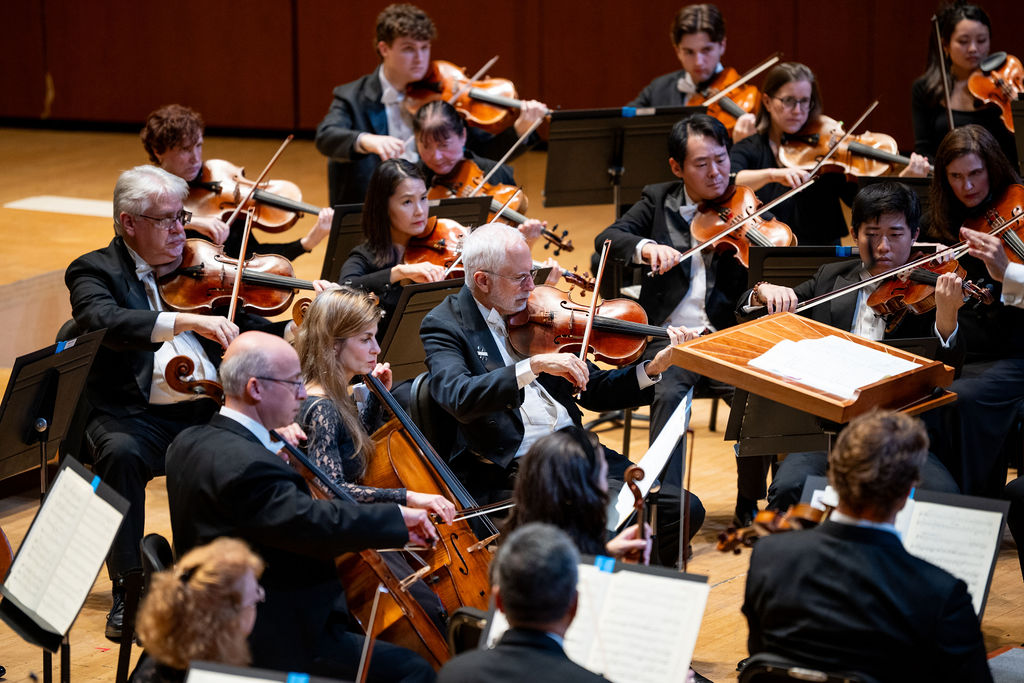
That segued nicely into Johannes Brahms’ Academic Festival Overture, Op. 80. It was a piece that, like its predecessor on the program, was short, concise and familiar. Those two pieces — which had a combined total of just over 30 minutes — made for an opening half that felt like a nice buildup rather than a monumental hurdle with more to come. That served nicely to set the stage for the evening’s main event, Brahms’ Concerto No. 2 in B-flat major for Piano and Orchestra, Op. 83.
This concerto is an interesting piece to hear from a contemporary standpoint because it seems to echo so many famous works that have come since its writing. The opening allegro non troppo brings to mind so many subsequent works that I felt like I was hearing a remix DJ spinning the Star Wars fanfare on one turntable and the main theme from Space Quest IV: Roger Wilco and the Time Rippers on the other. It is, simply, the sublimely anthemic-rendered kaleidoscopic by a composer who wore his inner turmoil on his compositional sleeve (and pretty much everywhere else).
In the midst of that bombast that appears to be springing from two satisfying sources at once is a piano solo whose phrases seem intended to antagonize that transcendent beauty. It’s an interesting dichotomy and one that speaks to the fearlessness in Brahms’ writing: He’s unafraid to paint a gorgeous landscape, then take a knife to it.
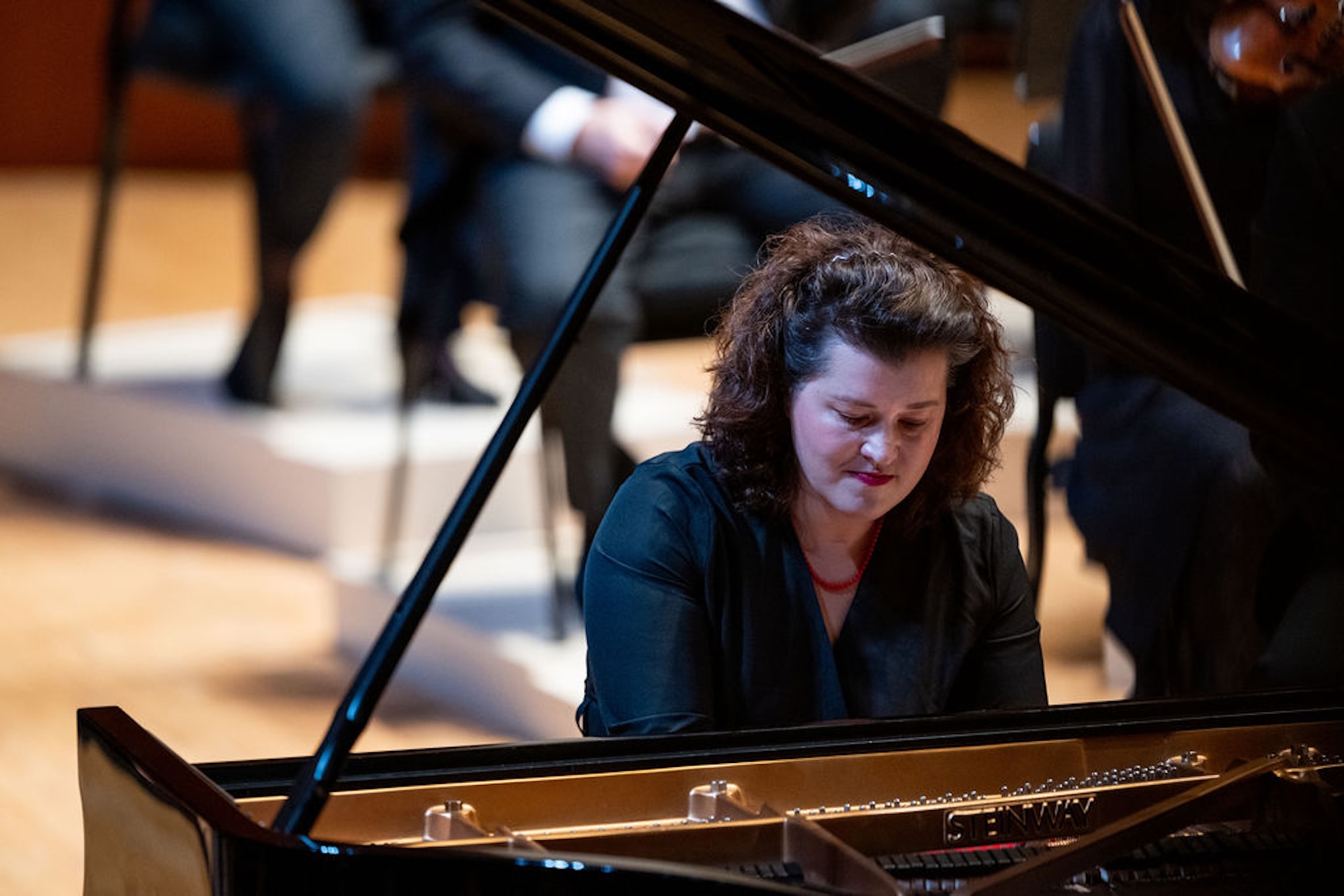
Guest pianist Anna Geniushene brought a tight command to the notoriously intricate piece whose success hinges largely on the skill with which one works the pedals. That might seem overly exacting, but in a work where harmonic density from the soloists risks compromising the delicate beauty all around it, things like sustain and reverberation matter in their most minute detail.
Geniushene was on point in her handling of those and other facets of the piece, and it allowed for a full and complete appreciation of a composition that feels like a foray into styles that didn’t exist in Brahms’ lifetime. There are passages that sound like hard bop jazz from a composer who died when blues was only in its gestational period. There are arpeggios that evoke the cyclical sweeping runs favored by electric guitarists during the 1980s. The musical lexicon that has emerged in the almost 130 years since Brahms’ death has served to make the piece all the more radiant, even as its clairvoyance feels haunting.
Time and again, I noticed that Geniushene would come to the end of the various solo passages and bounce her leg energetically. I had to think she was burning off the excess adrenaline from such intense phrases, but, even if not, it was still a great visual addition to the performance.
Though Geniushene was captivating, it proved to be ASO cellist Daniel Laufer who won the night. His delicate solo came in like a nurse who administers a syringe with such deft care that the puncturing of skin seems distant and almost pleasant. It was a subtle but remarkable high point that was stunning in the way that the orchestra seemed, one by one, to bow to the presence of his performance.
We’ve seen such things play out in cinema countless times: A furious mob clashes loudly and then suddenly becomes aware of a single, solemn outsider who enters the fray in a quiet and unassuming manner. That Messianic arrival cues the pack to step aside and watch the entrance in quiet reverie. And as in such cinematic moments, the light in the chamber seemed to bend toward Laufer as he played.
If the ASO intends to remain a stalwart devotee of the upper echelons of the classical canon, this is the right way to do it. There was an enthusiastic appetizer, a richly satisfying main course and transcendent energy throughout.
Where and when
One performance remains, at 8 p.m. on Saturday, November 7, at Symphony Hall.
::

Jordan Owen began writing about music professionally at the age of 16 in Oxford, Mississippi. A 2006 graduate of the Berklee College of Music, he is a professional guitarist, bandleader and composer. He is currently the lead guitarist for the jazz group Other Strangers, the power metal band Axis of Empires and the melodic death/thrash metal band Century Spawn.
STAY UP TO DATE ON ALL THINGS ArtsATL
Subscribe to our free weekly e-newsletter.

PLEASE SUPPORT ARTSATL
Your Gift Sustains the Coverage You Count On!
Related Posts