

Atlanta illustrator Anderson Carman is making graphic history with a Civil War comic textbook
When Anderson Carman decided to collaborate on a comic textbook about the Civil War with history professor Andrew Fialka, he shot for the moon — and even looked up its phases.
::
What do you get when you cross a historian with a comic artist? Maybe a clever punchline but definitely an intriguing, genre-crossing work from one of Atlanta’s visual storytellers.
The self-descriptive Hope Never to See It: A Graphic History of Guerrilla Violence during the American Civil War depicts a dark part of Missouri’s history in which a “downward spiral of violence” produced gruesome casualties on both sides. Made to be studied in college classrooms, this new textbook from the University of Georgia Press turns a peer-reviewed history book into a comic book.

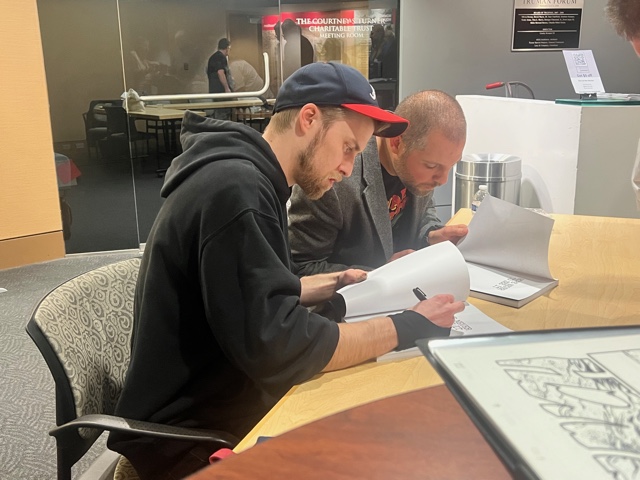
“I would argue that comics can be a better teaching tool because you have to actually slow down and figure out what’s happening in the pages,” says illustrator Anderson Carman, wearing an Atlanta Braves cap during the video interview. “If I’m doing my job as the visual storyteller, I’m engaging you to think critically about it.”
A graduate of Atlanta’s Savannah College of Art and Design, Carman became attached to Hope Never to See It when a former SCAD professor connected him with a colleague in Tennessee in search of an artist to collaborate on his book for tenure.
The author, history Professor Andrew Fialka, thought it a shame for his labor of love to be relegated to the typical academic echo chamber with no real audience besides other academics researching their own papers. His solution was to partner with an artist to create a much more engaging work for a much broader audience.
“We both just kind of treated this like jazz,” Carman says, adding that Fialka actually moonlights as a drummer. The unlikely duo collaborated over long distance for almost five years, Fialka sending Carman scripts and sometimes rough renderings, Carman sending back initial sketches for feedback, and so on.
“He’d say, ‘These guys are holding this guy up at gunpoint.’ So I’d send him back a drawing of people pointing rifles,” Carman explains. “He [would reply], ‘Actually, historically it would be pistols.’ So then I’d send him back pistols and he [might say], ‘That composition isn’t what I was thinking and it’s way better.’”
Judging by his diverse work, which spans from gritty books like this to his webcomic, Cyber League Baseball, Carman seems up for anything. But this was his first piece that would need to withstand an academic peer review.
“For some of my other projects, if [I draw] a sheriff’s badge, for instance, and in one of the panels it’s slightly different, it doesn’t matter,” he says. “But with this, I was plugged in a lot more to the details, thinking, ‘This has to be one hundred percent clear and accurate, because, if it’s not, someone will say something.’”
Especially tricky both for Carman and Fialka was figuring out how to merge the inherently creative aspects of this medium with the rigidity of academia. This showed up most significantly with historical figures of whom there are no pictures or renderings at all, such as, inconveniently, the main character of the story.
“When we took it to peer review, some of the initial feedback we got was, ‘Well, since you don’t know that’s what he looked like, you can’t say this is what he looked like by drawing him this way,’” Carman says. In the end, the loophole they found involved writing a disclaimer in the introduction, indicating the work utilizes “artistic interpretations” based on primary source material.
While not entirely unheard of, there is hardly an established precedent for peer-reviewed comic history books. The American Historical Review only just added such “graphic histories” to its review list in 2018, so this piece is right on the cutting edge of the genre.

“There have been other heavily researched works, one of the most notable being From Hell by Alan Moore, which is about Jack the Ripper,” Carman says. “But that tradition is not very strong within comics. So [Hope Never to See It] is kind of a proof of concept for this type of way to tell a story.”
As foreign as the academic world was to Carman, he thrived with a much higher standard to adhere to. He even included one historical detail unlikely to be fact-checked by anyone.
“There are a couple nighttime sequences that are dated, so I looked up the moon phase for that day,” he says. “I didn’t want it to just be any moon because I could actually find what it looked like.”
Carman’s closely following project, just released this month, is the first of a middle grades series about famous athletes. It may sound like the polar opposite of Hope Never to See It, but the artist said the dark textbook was a helpful precursor.
“I actually took a lot from Hope Never to See It because I had to really practice my likenesses, drawing recognizable faces. And that’s been quite the growing pains for me, he says. “Soccer Stars is about real athletes. So we really had to push the likenesses to make sure that they were recognizable.”
When fans visit Carman’s booth at Atlanta’s upcoming comic convention, MomoCon, he will likely be one of the only artists selling a graphic history and creating personalized baseball commissions, alongside the typical fare of superheroes and fantasy characters.
“I used to be really worried about pigeonholing myself into one genre or the opposite — I was really scared of being too diversified,” he admits. Now, he realizes the through lines in his diverse work are his passion and his ability to meet the demands of any project, no matter the subject.
And Carman’s next chance to collaborate on a graphic history may not be far away.
“I actually was approached by another historian wanting to make his graphic novel based off of a book that he wrote,” he says. “I can’t share any more details, but that’s very exciting to me.”
::

Sally Fuller is a theater nerd and journalist with a passion for telling people’s stories. Her work has appeared in Encore Atlanta, City Lifestyle Magazine and the AJC, among others. When not writing, she works at her dream job as a mother, alongside the best husband/father in the world.
STAY UP TO DATE ON ALL THINGS ArtsATL
Subscribe to our free weekly e-newsletter.

PLEASE SUPPORT ARTSATL
Your Gift Sustains the Coverage You Count On!
Related Posts

