
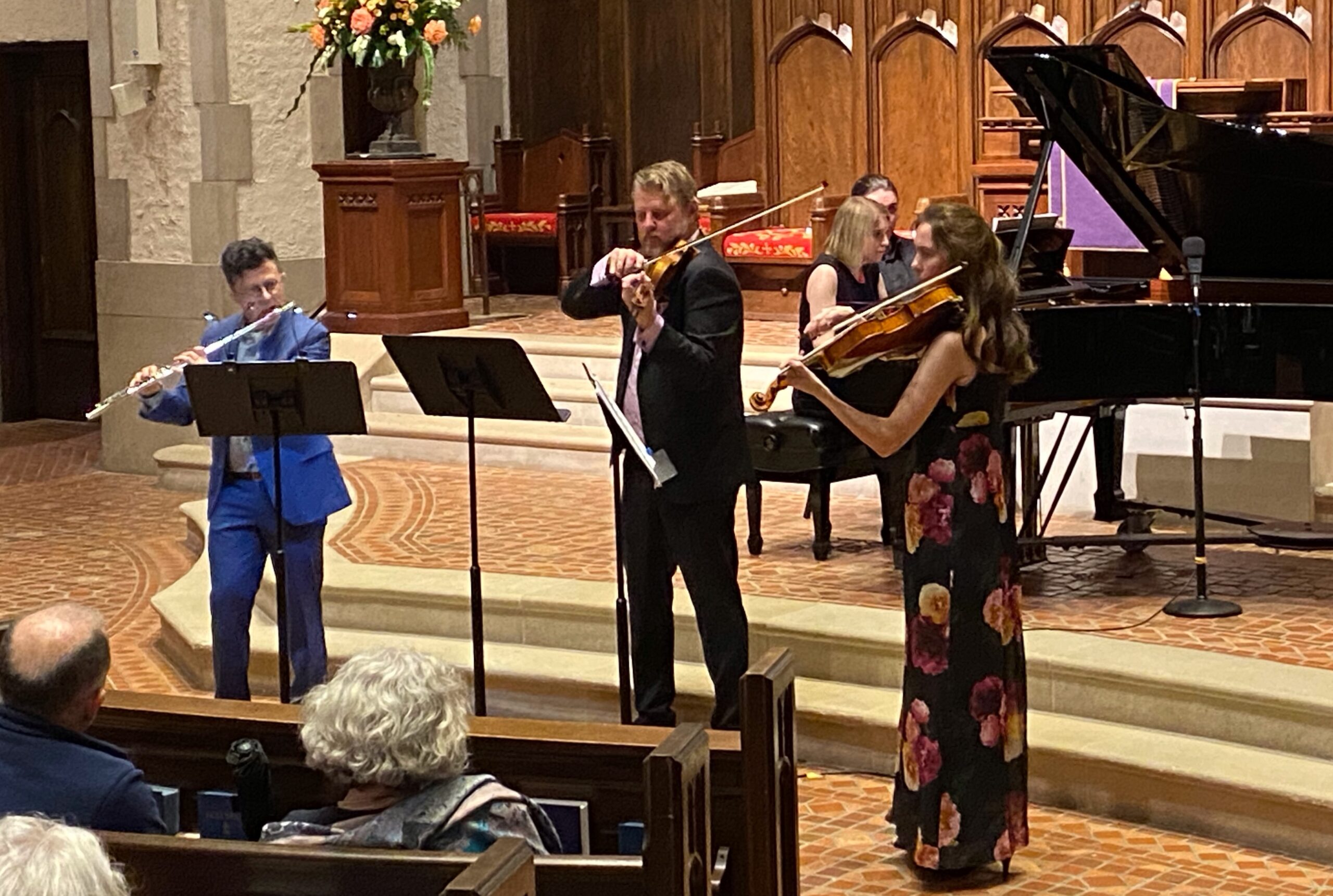
Atlanta Chamber Players offer dynamic takes on Beethoven and a world premiere quartet
Allen McCullough’s unorthodox and harmonically dense ‘Precipice’ was the April 6 concert’s centerpiece.
::
The Atlanta Chamber Players took the stage at First Presbyterian Church of Atlanta on Friday, April 6, for an afternoon of Beethoven coupled with a new work by composer Allen McCullough. The performance proved to be a stylistically vast offering from one of the city’s most prominent chamber ensembles.
The afternoon opened with Beethoven’s Violin Sonata No. 8 in G Major, Op. 30 No. 3, with Atlanta Symphony Orchestra Associate Concertmaster Justin Bruns accompanied by ACP Artistic Director Elizabeth Pridgen on piano. Bruns showcased a tone that captured the fire and fury of the piece while still maintaining the conversational tone of a seasoned veteran of the instrument.
That balance gave Pridgen room to breathe in her dialogue with the violin. Years of reviewing Pridgen’s performances have shown her to be an accompanist par excellence, and her ability to fill the dynamic space around Bruns’ performance underscored that accolade. Beethoven’s 8th Violin Sonata covers a wide emotional palette, and one cannot overstate the importance of lush, engaging accompaniment in such a minimalist context.

Pridgen left Bruns in the company of violist Catherine Lynn and flutist Todd Skitch, both of the Atlanta Symphony Orchestra. The trio performed Beethoven’s Serenade in D Major, which aimed at similar atmospheric territory as the preceding sonata. The work was enjoyable on the whole but it leans heavily on the flute, and, while Skitch is an undeniable master, he spent the performance wrangling coherent tones out of the ambient reverb of an uncooperative acoustic space.
Beethoven has been enjoying a modest renaissance in the Atlanta area, owing to the ASO’s expansive Beethoven Project. While the composer’s catalog is never far from any given orchestra’s repertoire, the ASO’s ambitious goal of playing eight of Beethoven’s symphonies in a single season (with the ninth and final symphony set to open the next season this fall) has brought a renewed local interest in his artistic vision (especially in the pages of ArtsATL). As such, performances of his smaller chamber works are a nice side dish to that epic main course.
The afternoon’s centerpiece was the premiere of “Precipice,” a new composition by Allen McCullough made possible through a grant from The Halle Foundation. Though the composers bore little resemblance in terms of style, it was, nevertheless, an appropriate pairing: Beethoven was a boundary pusher in his day and McCullough follows suit in the modern era (although to considerably less fanfare).
In McCollugh’s opening remarks for the piece, he emphasized a love of the traditional musical components of melody and counterpoint. It was an interesting observation in light of the piece’s swirling, often harmonically dense modernist style.
“Melody has had to expand beyond a diatonic collection of major and minor scales,” McCollough explained in our discussion following the performance. “I like to have a harmonic universe that’s freely chromatic.”
The possibility of building melodies around all 12 notes as opposed to seven notes relegated to a specific key was an appealing challenge for McCullough, and, as disorienting as the work often is, it succeeds on the whole with moments of rich, textural harmonies and melodic lines that turn on a dime from madcap to melancholic.
“Precipice” saw Pridgen return to the stage with Skitch, Lynn and Bruns and it was this instrumentation that gave the piece its name. With no significant bass range presence outside of the pianist’s left hand, McCullough found it difficult to provide the sort of grandiose climactic passages that would normally close out a classical work. As such, the piece felt eternally on the precipice of something larger.
“I think we had to look more for motivic development,” observes Pridgen with regards to the piece’s unorthodox nature. Pridgen, whose association with McCullough goes back years to when they were both on the faculty at Mercer University (McCollough has since moved on to Purdue), has a long and ongoing history of performing the composer’s music.
Pridgen sees this new composition as a testament to McCollugh’s evolving style. “I hear hints of the music he wrote 15 years ago, but I also hear that he’s grown and developed as a composer.” She remarks that preparing the work was a daunting task — especially given its rhythmic complexity — but ultimately a rewarding journey.
“In a way, it was like discovering him all over again,” she says of the intense process. That enthusiasm for new works will continue into the ACP’s next season, which will mark the ensemble’s 50th year. In five decades, the Atlanta Chamber Players have evolved from a jovial side gig for the ASO’s best and brightest into a dynamic and innovative ensemble in their own right.
::

Jordan Owen began writing about music professionally at the age of 16 in Oxford, Mississippi. A 2006 graduate of the Berklee College of Music, he is a professional guitarist, bandleader and composer. He is currently the lead guitarist for the jazz group Other Strangers, the power metal band Axis of Empires and the melodic death/thrash metal band Century Spawn.
STAY UP TO DATE ON ALL THINGS ArtsATL
Subscribe to our free weekly e-newsletter.

