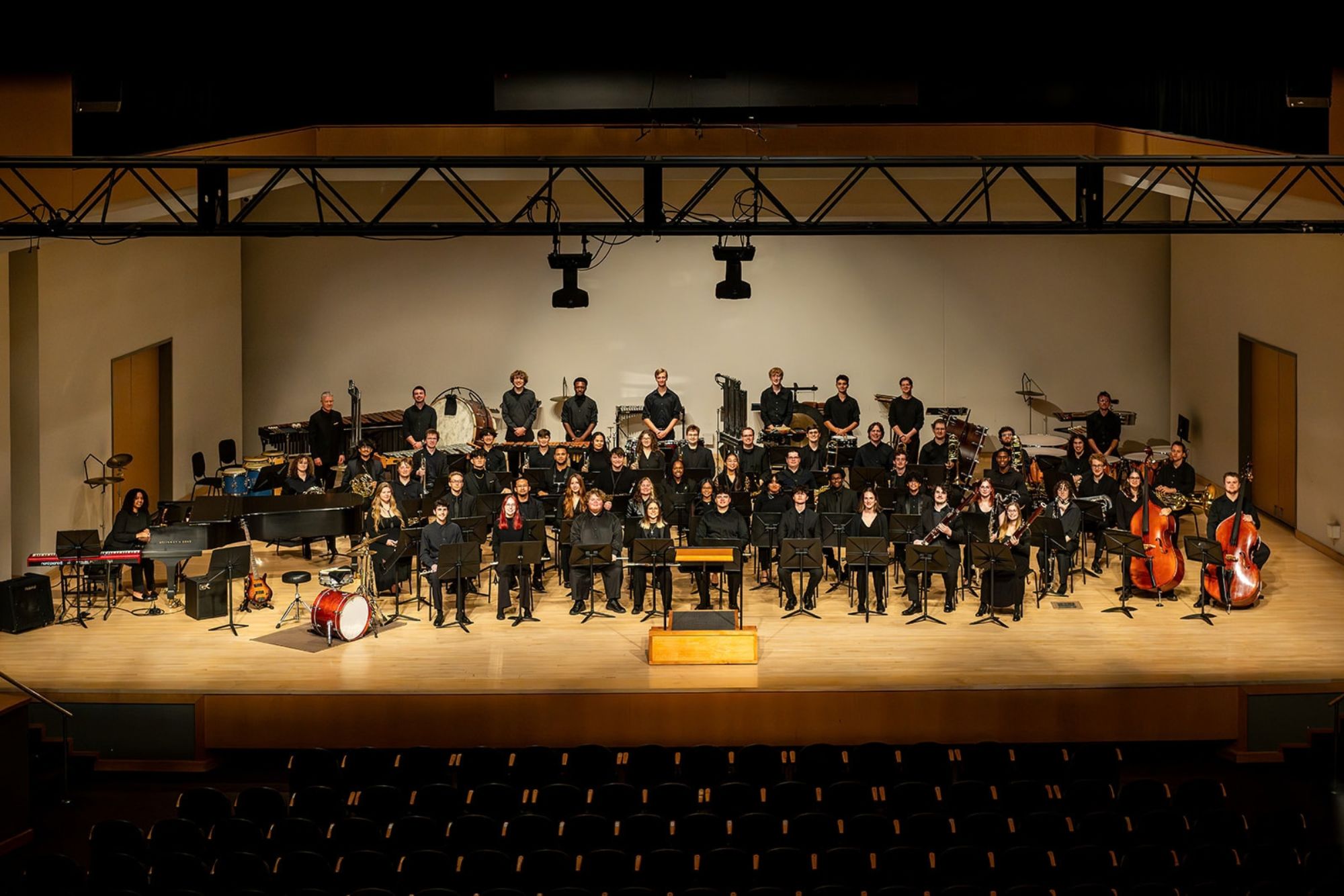
A colorful, melodic new work highlights KSU Wind Ensemble’s upcoming performance
Kennesaw State University Wind Ensemble Director David Kehler answers my opening “How’s it going?” with some cheerful sarcasm.
“World’s coming to an end, AI is going to kill us all, but other than that, everything is good, right?” he laughs. It’s a sobering quip about the tense nature of our modern world, but Kehler’s own outlook proves to be far less fatalistic. Nevertheless, it’s a pertinent observation for the subject matter at hand.
The KSU Wind Ensemble will be presenting the Georgia premiere of Ryan Lindveit’s Color Theory on September 29. A new work, the piece was a joint commission in partnership with Indiana University, Michigan State, Baylor, Florida State, the University of Michigan and the University of Tennessee, Knoxville. The latter school spearheaded the commission, as it’s where Lindveit used to teach.

For Kehler, such commissions are well-worn territory. “I’ve done this almost three dozen times now,” he explains. “Ryan and I met a couple of years ago. He’s a young guy — he’s about 30 years old, and I think his writing is brilliant. I’m just trying to help support some new music by some very new talent. He’ll be at the concert as well.”
Kehler describes Color Theory as a symphony of sorts for wind ensembles. “It’s based on paintings by various artists of the 20th century,” explains Kehler.
To that end, I had to pose my usual concern about new classical music — that all too often, “modern” is secret code for “no melody.”
“It’s very melody-focused,” affirms Kehler. “It’s not programmatic but …” he pauses and moves to push back further on my premise. “When I was a kid at Michigan State, everyone in the ’80s had to study [Arnold] Schoenberg and twelve-tone, and you had to write that way, even though he’d long been dead. We started to see a change about 25 years ago where composers could write whatever’s inside of them. I think what you’ll hear is a very virtuosic piece.”
Kehler’s affirmations prove to be well-placed. Listening to a recording of an earlier performance of the piece, it becomes clear that Lindveit has a penchant for drawing rapid-fire melodic engagement from states of controlled chaos. There’s a glorious sort of mad scientist aura around the whole thing, and the listener’s appreciation of the piece begins first as an act of faith that the mastermind behind this whole thing has a coherent vision in place, much as it defies our own understanding. Time and again, our faith is rewarded.
“I think Ryan is a brilliant orchestrator,” Kehler observes. “He knows really well how to write for winds and percussion. His writing is beautiful, and his colors are beautiful. He’s used visual art to inspire his aural art. It’s a very colorful piece; it’s a fun piece; it’s a dynamic piece. And it’s very challenging, too.”
Lindveit’s presence will continue to resonate across the KSU Wind Ensemble’s current schedule: Don’t be Evil is a piece that opens the second half of the season. The title comes verbatim from Google’s infamous motto, one that seems savagely ironic in the age of AI, tech bros and corporate surveillance. Kehler’s earlier sentiments come back into sharp focus.
“That’s one of their sayings at Google, which is ridiculous,” he continues. As Kehler explains, it’s a sentiment born out of Lindveit’s having grown up entirely inside the modern technocratic world — something that those of us blessed to have lived through the ’80s and ’90s can’t relate to.
The stridently sinister piece sounds like George Gershwin by way of Franz Kafka. It’s a work meant to convey the sheer absurdity of Google’s institutionalized doublethink. The paranoia and brain fog are readily apparent in the work itself, but it remains captivating and listenable nonetheless.
Above and beyond the cyber-apocalypse atmosphere that the work creates, there is a clear individual vision and a spark of originality. That, above all, is what Kehler wants to celebrate in Lindveit’s work.
“I think the biggest challenge now is for composers to find their voice,” he asserts. “There are no rules for what you can and cannot do. I think in some hands, that’s awesome; in some hands it’s completely debilitating.” Lindveit, Kehler maintains, has found that personal voice, wildly variegated though it is.
::

Jordan Owen began writing about music professionally at the age of 16 in Oxford, Mississippi. A 2006 graduate of the Berklee College of Music, he is a professional guitarist, bandleader and composer. He is currently the lead guitarist for the jazz group Other Strangers, the power metal band Axis of Empires and the melodic death/thrash metal band Century Spawn.
STAY UP TO DATE ON ALL THINGS ArtsATL
Subscribe to our free weekly e-newsletter.

PLEASE SUPPORT ARTSATL
Your Gift Sustains the Coverage You Count On!
Related Posts