Terminus turns 10: ‘Out of the Box IV’ is an entrée to the ethos of the Modern Ballet Theatre
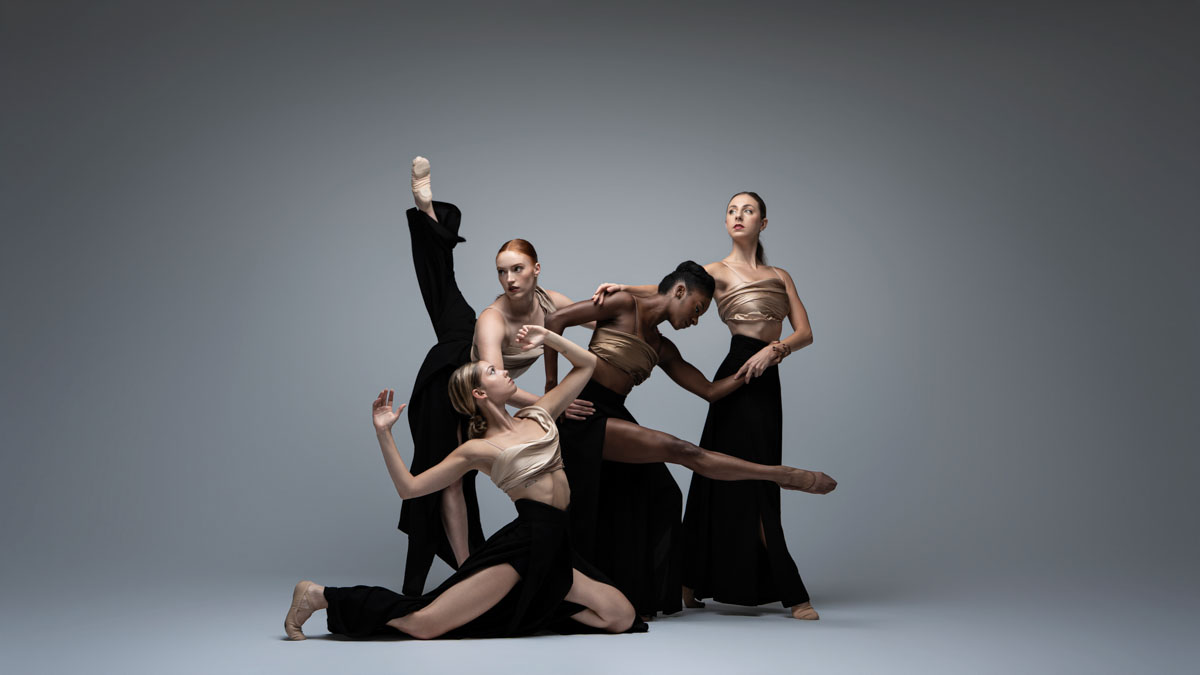
Celebrating the opening of its 10th season, Terminus Modern Ballet Theatre continues a tradition. Out of the Box IV is the fourth installment of a series that presents the ballet company’s core strengths: original choreography, storytelling and a blended, modern-meets-classical style. The series’ name exemplifies the group’s artistic approach, and each installment has served as a season opener, an entrée to its ethos.
This year’s edition, staged at Tula Arts Center September 19 through September 27, features one new work — A Mi Lado by Chicago-based Stephanie Martinez — and two returning works — Confronting Genius and Tiny Universe, by Terminus co-founders Heath Gill and Tara Lee, respectively.
A Mi Lado is a fervent opening act. Throughout the piece, the eight dancers run across the stage and leap into the air or each other’s arms. Nearly nonstop acrobatics and swift movements demonstrate the athleticism of this art form. As the piece progresses, the air in the theater palpably heats from the dancers’ exertion. The arduous and allegro piece has no moment of respite, only sections of reduced intensity.
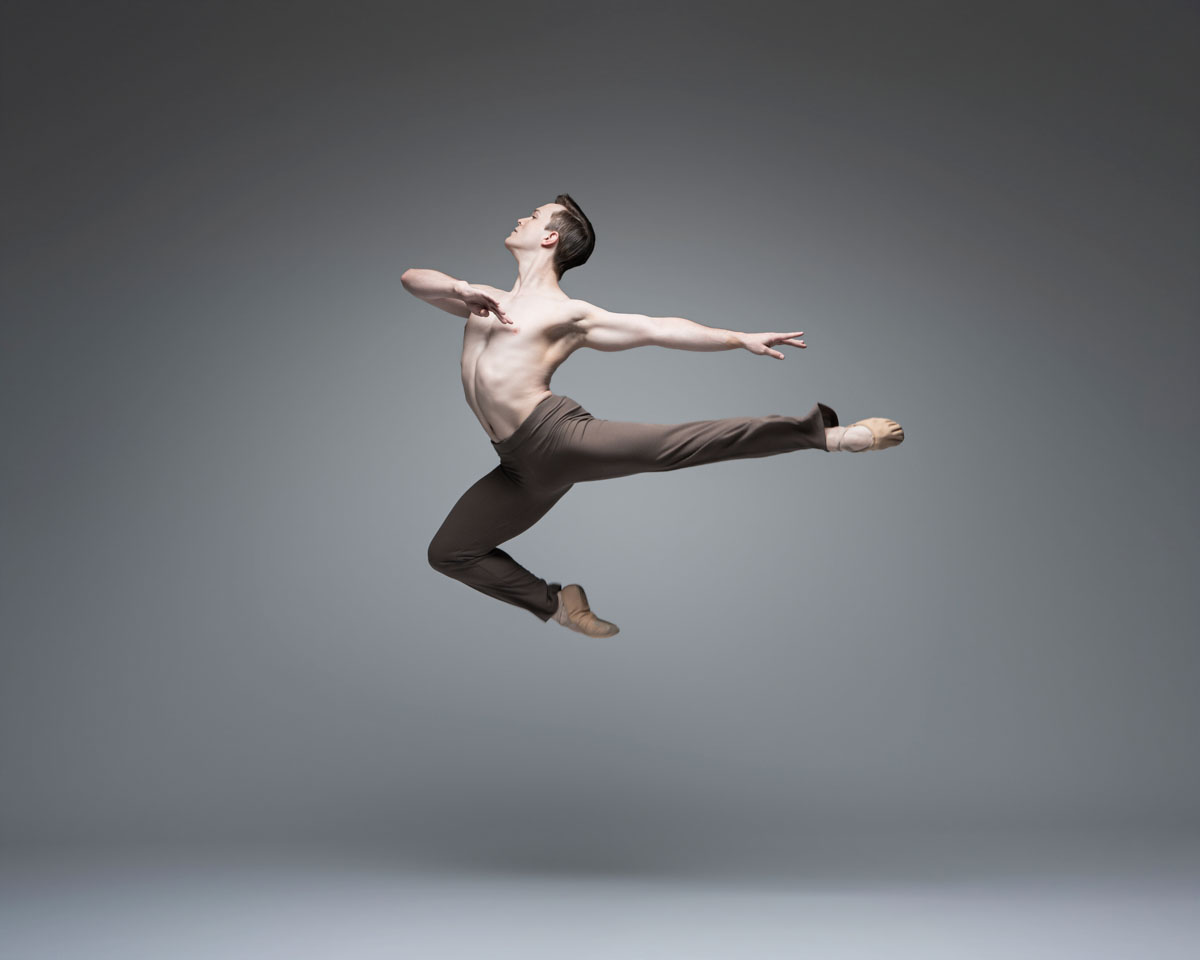
The dancers are often partnered in male-female duos and, although each pair’s movements are synchronized to the other pairs on stage, each feels distinct: their gazes lock; they act and react only to each other.
The fervency of the performance lessens only when certain pairs are poised, positioned at an edge of the stage anticipating their next entrance. In one of these attendant moments, the male dancers use their torsos and legs to push the female dancers, whose heads rest against their chests, to the front of the stage, where they turn their backs to the audience and sit, watching the only remaining pair continue their program.
In the White Box Theater at Terminus, absent of physical delineation between stage and seating, the settled dancers’ immediacy heightens the audience’s experience, yet the dancers’ bodies — pressed against the seating with their backs turned — express an indifference to the onlookers. The dancers are not performing for us, they are performing for themselves. But how lucky we are to be so close to such skilled abandon.

As a duet, Confronting Genius feels more spacious. Danced by one male and one female, the duet unfolds to words of a recorded recitation of writer Elizabeth Gilbert’s musings on creativity, spoken by Terminus dancer Jackie Nash. The choreography is frequently a literal enactment of the spoken words, the dancers’ interactions and facial expressions mirroring the tone and content of the heard sentences. Overhead, a large Edison-style light bulb blinks on and off, a trope for the moment creative inspiration strikes.
The two dancers directly interact throughout, but there are many moments when they separate from one another. In one of those instances, the female dancer rests on a revolving stool — the piece’s only prop — adopting the well-known position of The Thinker (1880) by Auguste Rodin. As she is lost in thought, the male dancer continues to move, though now more freely navigating the ample space. The recitation speaks about creativity broadly — identifying misconceptions, negative side effects, beautiful manifestations and frustrations — as seen in the lives of Gilbert and other creatives. While not explicitly indicated, the performance reads as an affirmation of Gilbert’s musings: Here, too, these things are true. The piece humanizes the dancers. While the decision to be literal posed the risk of becoming overly hokey, the choreography acts as an emphasis on the narrative, not an extrapolation of it. Using familiar and legible movements demystifies the dancers. The spoken words ground them in a messier reality; the performance’s tone brings levity and humor to the art form.

It feels fitting that the final act, Tiny Universe, is choreographed by Terminus’ cofounder—Tara Lee, now the rehearsal director—and that the number is performed by almost the entire company. Though using nine dancers, it rarely feels like it. The choreography moves the dancers as an interrelated group — expanding, contracting, reshaping, rising and falling like a swarm of swallows. For brief moments, an individual dancer will leap out from the group to execute an ostentatious move — like a pirouette a la seconde — but they never remain apart for long. The focus gained from such a prominent movement is then passed along to another dancer who begins to move distinctly within the group, and the process continues. While moving as one, there is always an observable locus. The ever-changing nature of the group evokes turbulence, an unpredictable yet fluid flux.
The piece concludes with eight dancers lining across the metaphorical proscenium — their backs to the audience; their arms around their neighbors’ waists. The ninth dancer crashes against this wall, like in a game of red rover but without the exuberance. She reaches toward the audience, her hand grasping at air, before she, too, turns around, lifts herself by clinging to two dancers, and the group marches in sync to the back of the stage. This piece makes the company’s ethos clear: Individuals are encouraged to dare and strike out, for they are never far away, and the group will always help carry them forward.
Out of the Box IV. September 19 through September 27. Tula Arts Center. 75 Bennett St. NW, Suite A-2, Atlanta. General admission tickets are $65; students $25. Tickets can be purchased here.

::

Leia Genis is a trans artist and writer currently based in Atlanta. Her writing has been published in Hyperallergic, Frieze, Burnaway, Art Papers and Number: Inc. magazine. Genis is a graduate of the Savannah College of Art and Design and is also an avid cyclist with a competition history at the national level.
STAY UP TO DATE ON ALL THINGS ArtsATL
Subscribe to our free weekly e-newsletter.

PLEASE SUPPORT ARTSATL
Your Gift Sustains the Coverage You Count On!
Related Posts