DeKalb Symphony flies high in season debut at Emory’s Schwartz Center
The orchestra’s newfound cohesion takes another leap forward despite unexpected last-minute changes.
::
The DeKalb Symphony Orchestra kicked off its new season at Emory University’s Schwartz Center for the Performing Arts on Tuesday, September 15. Now in its 62nd season, the orchestra has made notable strides under the direction of Paul Bhasin. Its new regular haunt, First Baptist Church of Decatur, has been a quantum leap forward since its days at Georgia Perimeter College. Schwartz proved to be another step up — the orchestra that once sounded like a badly warped vinyl now had all the detail of a high-quality digital restoration.
That additional sonic clarity paid off from the outset with concert opener Eugène Gigout’s Grand Chœur Dialogué, making full use of the stellar house organ. Normally I’m not a fan of organ features. All too often, they showcase sustain pedal-enamored players who, forced to perform in the hallowed halls of houses of worship, come off sounding like the Phantom of the Opera celebrating a successful rhinoplasty. That ambient wash of glassy melodicism was nowhere to be found Tuesday night, and DSO organist Jack Mitchener took full advantage of the pristine acoustics to deliver a stirring opening performance.
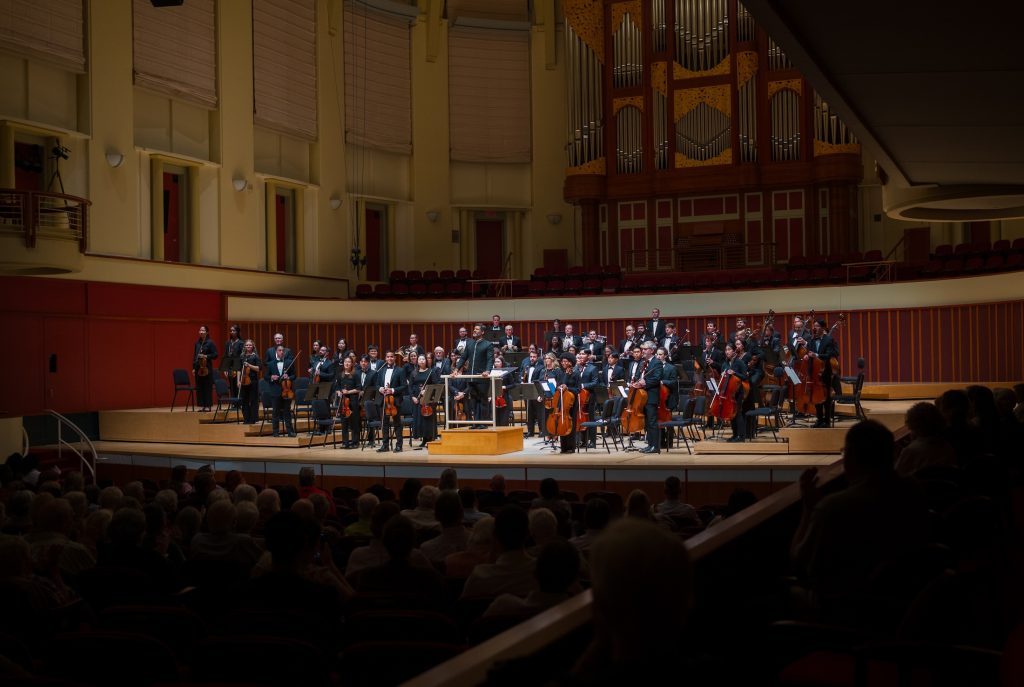
The evening’s guest soloist, pianist Albert Cano Smit, joined the orchestra for Tchaikovsky’s Concerto No. 1 in B-flat Minor for Piano and Orchestra, Op. 23. Although regarded as one of the composer’s more notable early works, it nevertheless lacks the melodic immediacy of his more legendary compositions. For a master melodicist like Tchaikovsky, that sidelining of this greatest strength has the potential to make his works seem aimless and needlessly exploratory.
Smit’s spotlight-commanding grandeur merged with that open-ended quality in the composition and created a sense of detachment from the orchestra as a whole. It wasn’t a poor performance by any stretch, but it had the most subtle aura of not being fully integrated with the larger ensemble, almost as though he had become so consumed by his own internal reverie that he was unaware that he’d overpowered his accompaniment.
Those overzealous moments abated after the opening allegro and once Smit and orchestra had moved on to the subsequent andantino semplice. There was a marked shift into a balanced cohesion. Soloist and ensemble had gone from a virtuoso game of tug-of-war to a refreshing synchronized swim.
Smit indulged in a surprise pre-intermission solo piece, a practice that I’ve always derided as needlessly self-indulgent and inconsiderate of an audience who, by that point, is likely yearning for a good stretch of the legs and a pleasant sojourn into the cool night air. But Smit used the moment for a pleasant Brahms intermezzo that proved to be his most enjoyable performance of the night. Captivating though it was, I still can’t fully endorse the practice.
The evening’s second half proved to have unexpectedly high stakes. DSO principal bassoonist Lazara Santana had been in a car accident earlier in the day, necessitating a last-minute replacement. “We probably started looking for people around 1 p.m. this afternoon,” explained DSO Executive Director Catherine MacGregor. Haste was made to find a fill-in, and the Atlanta Symphony Orchestra’s Cameron Bonner stepped up to the challenge.
“I don’t think he’s performed this before,” continued MacGregor. “He’s had no rehearsals.” She was understandably grateful. “We were close to flying in somebody from Miami.”
As MacGregor pointed out, the piece on hand was none other than Dimitri Shostakovich’s Symphony No. 9 in E-flat Major, Op. 70, a work that features a significant bassoon solo midway through the composition. While it would make for great reading to amp up the dramatic tension with references to triumphant underdog sports films and a simmering sense of uncertainty percolating among the audience members, the simple reality was that Bonner handled the challenge with such fluid ease that I’d almost forgotten about it by the time his actual solo arrived. (I’m just glad Jennifer Barlament, the ASO’s chief executive, stopped by and mentioned the change to me; otherwise I might have referred to him as “Lazara.”)
On the whole, the Shostakovich proved to be another testament to the DSO’s newfound cohesion: The excellent performance seemed less remarkable and more to be expected, and that consistency alone points to how far they’ve come. Once, their quality had peaks and valleys. Now they’re just flying high.
::

Jordan Owen began writing about music professionally at the age of 16 in Oxford, Mississippi. A 2006 graduate of the Berklee College of Music, he is a professional guitarist, bandleader and composer. He is currently the lead guitarist for the jazz group Other Strangers, the power metal band Axis of Empires and the melodic death/thrash metal band Century Spawn.
STAY UP TO DATE ON ALL THINGS ArtsATL
Subscribe to our free weekly e-newsletter.

PLEASE SUPPORT ARTSATL
Your Gift Sustains the Coverage You Count On!
Related Posts