Leia’s Long Look: Trapped in the interstitial by Kathryn Kampovsky’s ‘The Fade’
Leia’s Long Look is a new monthly column providing focused looks at individual artworks, prompting slow looking and deeper reflections. This month, Leia examines two paintings by Kathryn Kampovsky on view at Johnson Lowe Gallery through September 12.
Despite the frequent depiction of beds and resting bodies, Kathryn Kampovsky’s solo exhibition The Fade, on view at Johnson Lowe Gallery until September 12, is hardly comfortable.
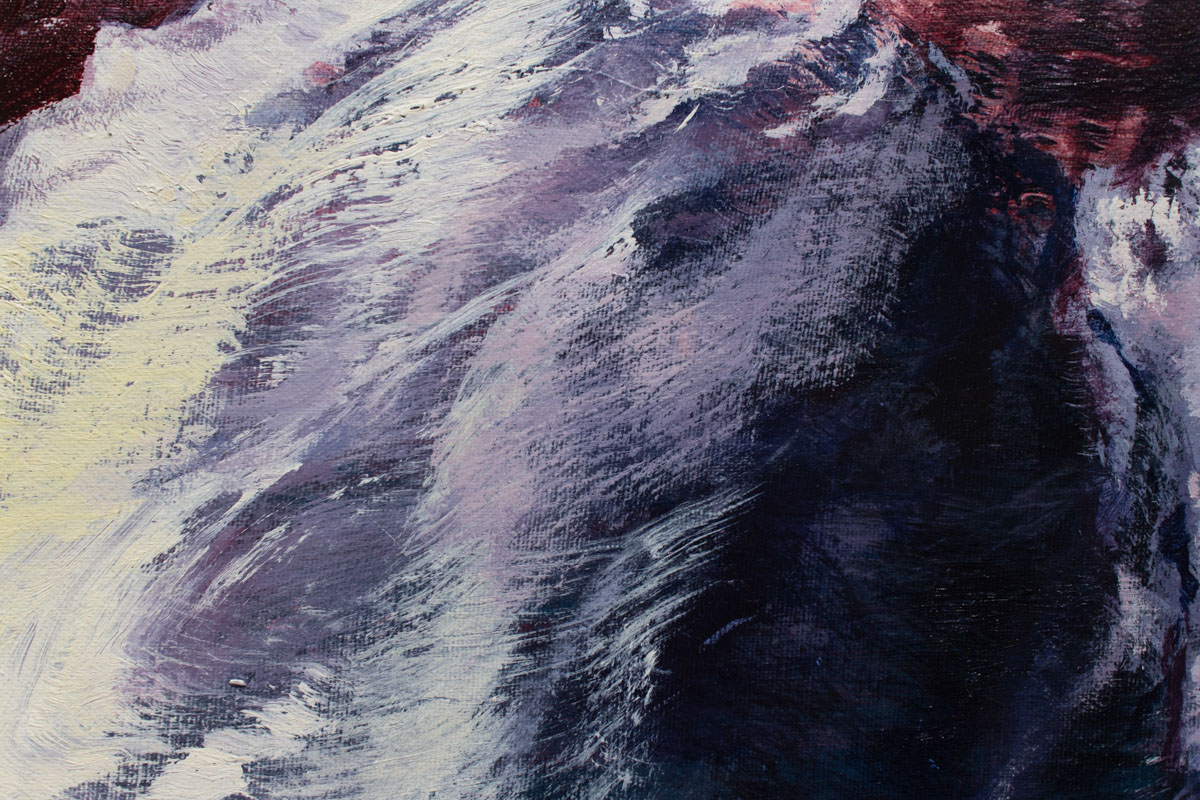
Using a variety of tools like strips of Styrofoam, taped wall edges and sponge gloves, Kampovsky paints figures, most seemingly feminine, lying on white sheets and pillows — or blue-green landscapes. But the makeshift nature of her tools and loose mark-making technique create streaky, rough strokes, layered until they are like palimpsests of color quivering with frenetic energy. She makes sure, though, to render just enough detail to distinguish features and objects.
Painted in this way, the relaxed posture of the lying figures is at odds with the chaotic atmosphere. It is clear these figures are not tranquil. But why are they so uneasy? The answer remains a mystery.
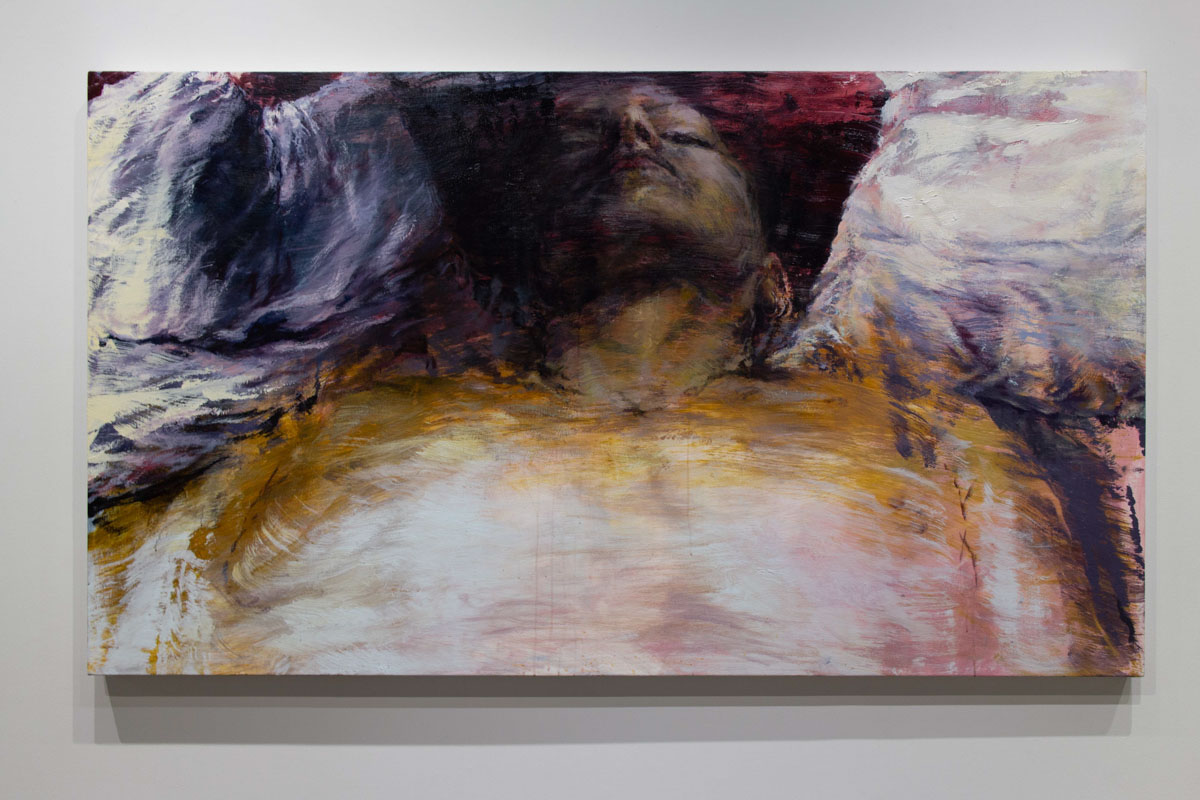
Toward the rear of the gallery hangs Spent (2025): a long, horizontal acrylic painting on canvas. The artwork depicts a foreshortened figure — seen from the abdomen up — lying between two pillows. The figure straddles the midline of the composition, making it the central focus, but the wide format instructs that it is not the subject. By choosing a format that minimizes the view of the figure and maximizes its surroundings, Kampovsky places equal emphasis on the pillows flanking the figure.
The figure’s head falls squarely between the two pillows yet touches neither. Although the figure is lying down, it is not comfortable. The real subject then is not the figure, but the discomfort of being trapped between two things.
This discomfort is exacerbated through Kampovsky’s choice of perspective. The foreshortening and crop of the figure place the viewer at its hips, gazing up at them as if engaged in oral sex. The empty expression and closed eyes of the figure do not allude to pleasure, so why then are we seeing this scene from such an awkward angle? Doing this implicates the viewer in the scene; we are not apart from it but nested within it. Why the figure does not embrace the comfort of pillows nor pleasure is unclear, as is our role in the scene. Neither we, nor the figure, find resolve. We are trapped in paralysis.
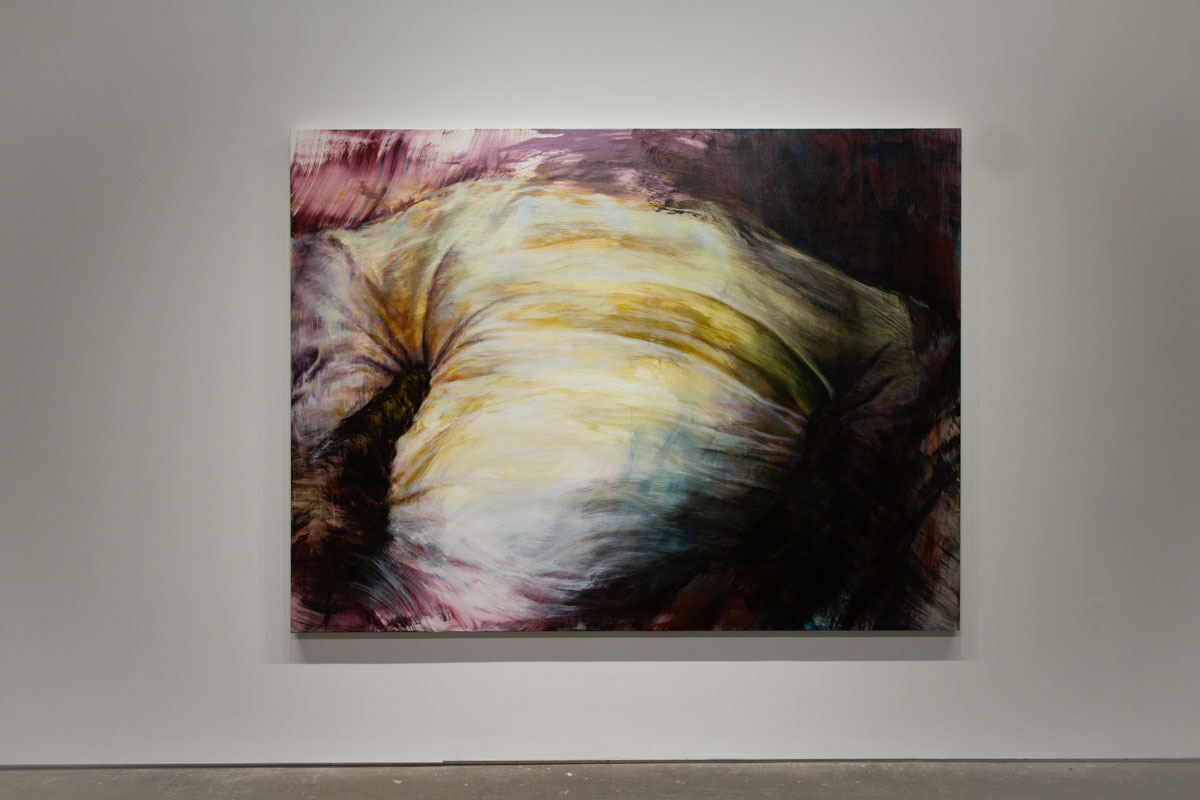
The back wall of the gallery holds Timefold (2026). A large, bulging, cream-colored form arcs across the composition. Where its luminescence ends, dark pits of plum, wine red and aubergine pool. Both ends of the form show creases cascading down toward depressed points, pinned by humus brown forms.
Seen in the context of the exhibition, it is inferred that the painting depicts a pillow grasped by two hands, though the artwork itself provides no such clues. Devoid of any easily identifiable objects or figurative elements, Timefold departs from the existential ambiguity of Spent in favor of ontological uncertainty. Do the inferred pillow and hands exist in the painting or only their implication? Again, we are caught between two things, with the artwork providing no conclusion.
A hint perhaps exists in the artist’s accompanying words: “The place of rest is scary but desired,” writes Kampovsky in the exhibition text.
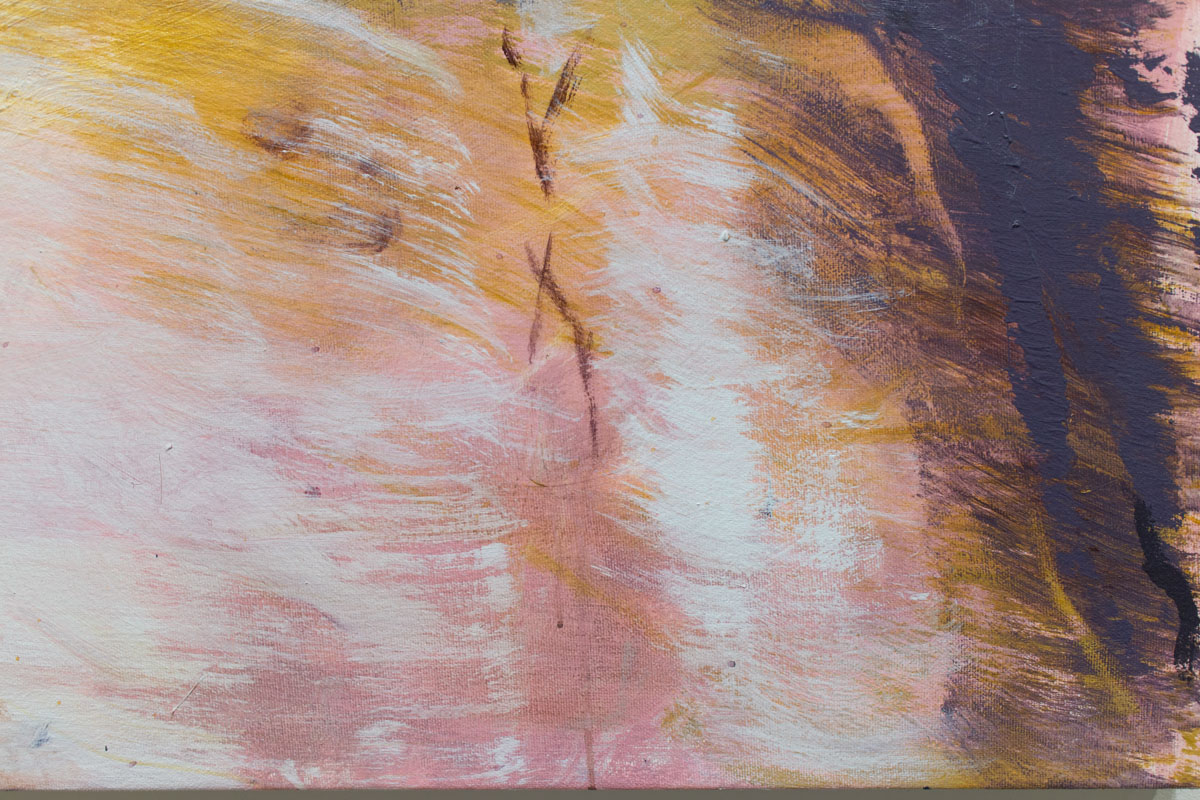
Against an unruly sea of brushstrokes, any place of rest would be desired — even an uncomfortable one.
Forcing the viewer to continually attempt to make sense of scenes, regardless of their legibility, is exhausting in its own way. We can neither totally relax nor totally engage, much like the figures Kampovsky paints. Such unrest summons emotion, but I wonder what, if anything, will arise from the experience beyond fatigue.
::

Leia Genis is a trans artist and writer currently based in Atlanta. Her writing has been published in Hyperallergic, Frieze, Burnaway, Art Papers and Number: Inc. magazine. Genis is a graduate of the Savannah College of Art and Design and is also an avid cyclist with a competition history at the national level.
STAY UP TO DATE ON ALL THINGS ArtsATL
Subscribe to our free weekly e-newsletter.

PLEASE SUPPORT ARTSATL
Your Gift Sustains the Coverage You Count On!
Related Posts