
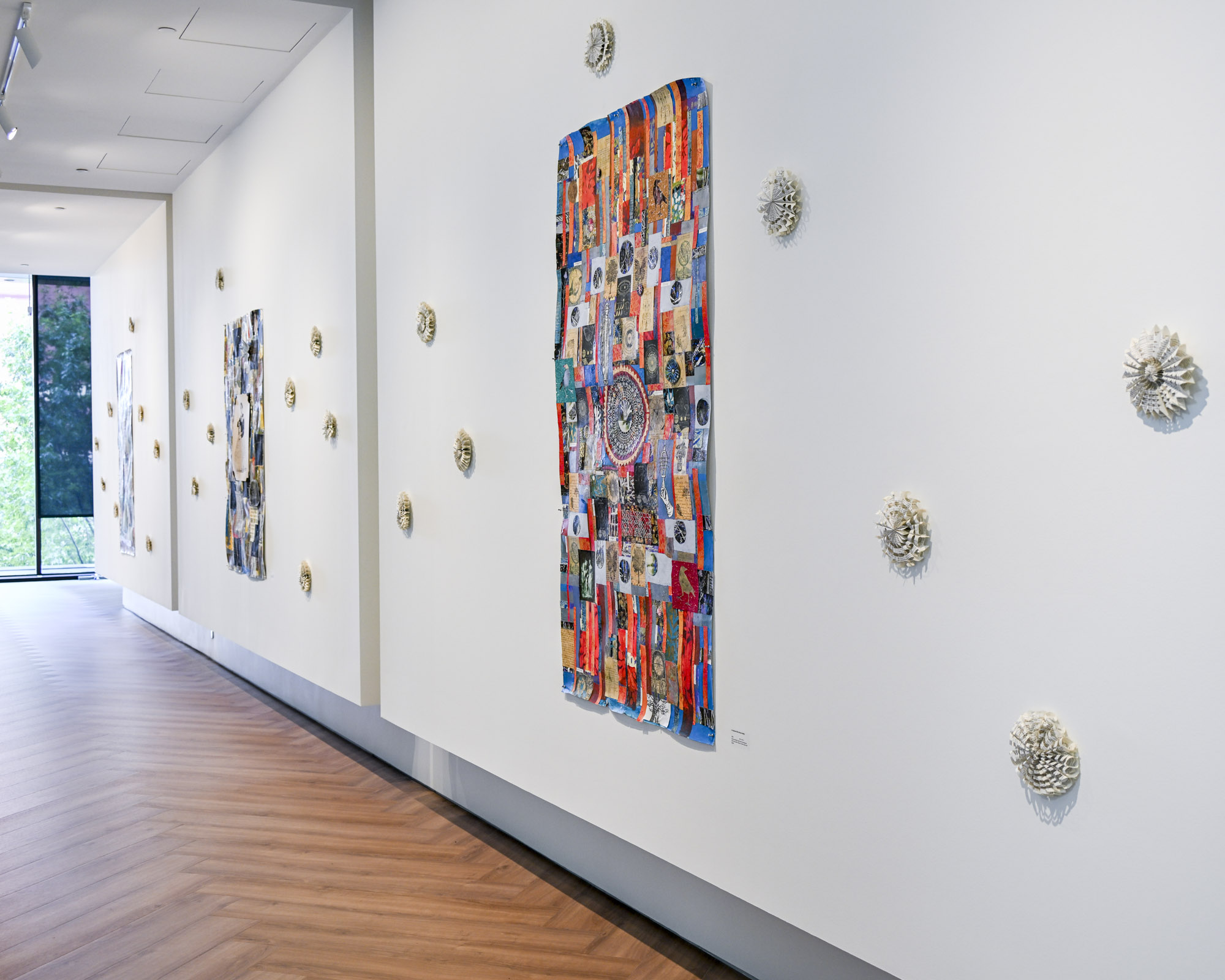
More than the room allows: Lisa Tuttle’s ‘Paper Quilts and Stories’ at Gallery 100
Lisa Tuttle’s Paper Quilts and Stories at Gallery 100 presents 13 mixed-media works that are quilts in both name and method. For the works, Tuttle has pieced leftover scraps and fragments from earlier projects into dense new compositions that are then layered with silkscreen, stencil, transfer and paint. As a result, they become rewarding objects, rich in incident and intimate in their making. What is overall a beautiful exhibition is limited only slightly by the conditions surrounding it — namely, the quantity of works, the setting and the manner in which it is hung.
The through line across Tuttle’s show is the way she handles the paper itself. Gel medium puckers sheets into low relief; layered scraps turn translucent where they overlap, such that a printed bird or a line of old script surfaces faintly through whatever was laid on top; in places, actual thread is stitched and embroidered directly into the paper. Folded book pages, mounted as paper snowflakes, lift off the wall in delicate dimensional bursts and form larger installations. These are works built to be approached closely, and they repay the viewer’s close attention in spades.
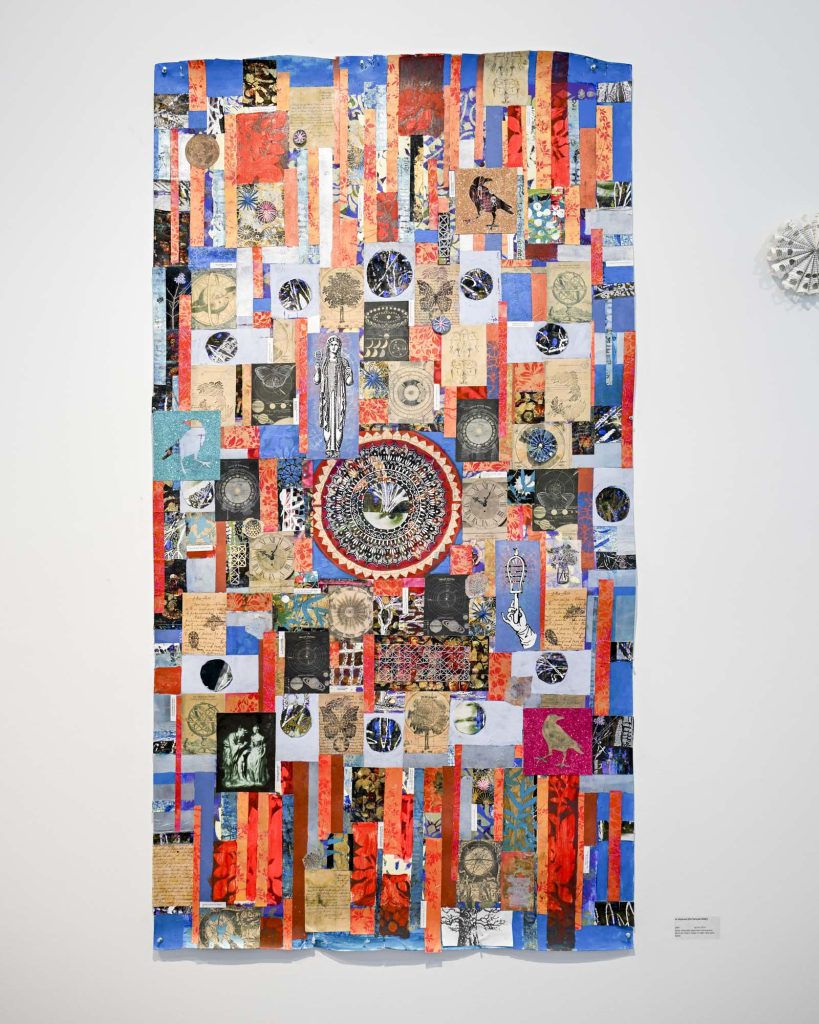
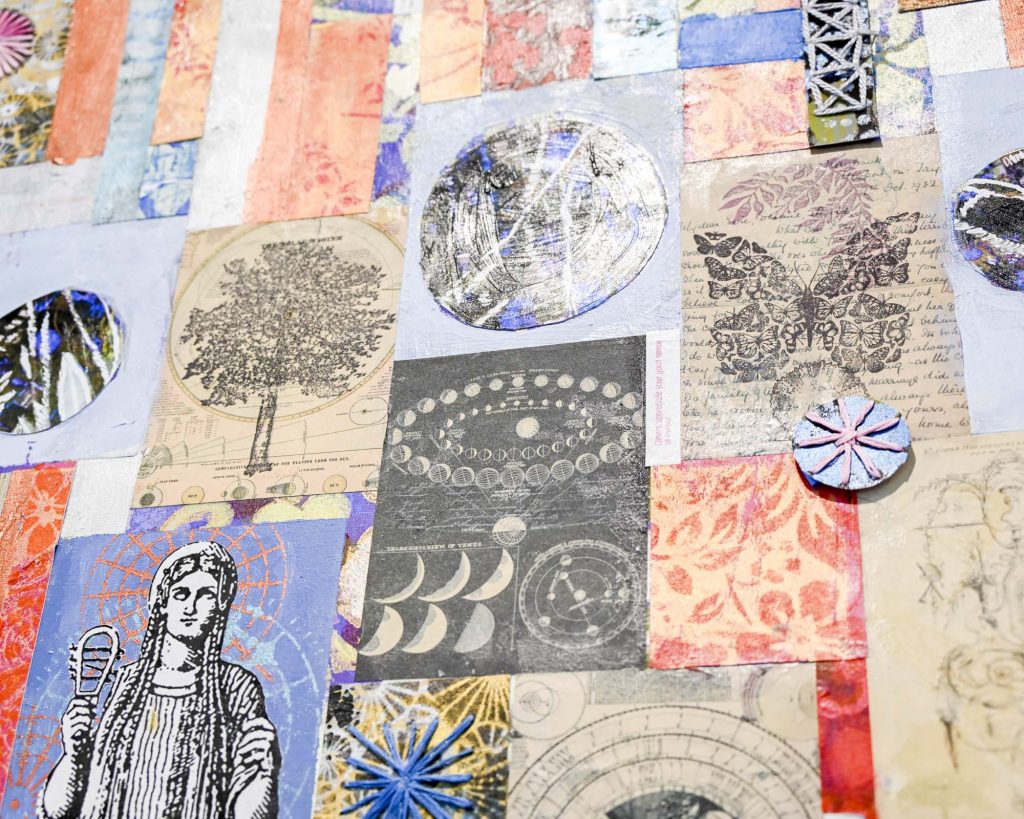

The most successful single work in this show is also the first one encounters upon entering the gallery. La Voyeuse (the fortune teller) is a tall, vertical field in which a central red mandala anchors images of clocks, ravens and small astronomical prints that showcase the moon’s phases paired with a diagram of the solar system. Among the printed fragments are fortune cookie slips, with one promising that “you may attend a party where strange customs prevail.” The brief lines read as incantations and imply that Tuttle has gathered these materials herself — over years — in a way that makes the accumulation feel personal and biographical, rather than sourced or leftover.
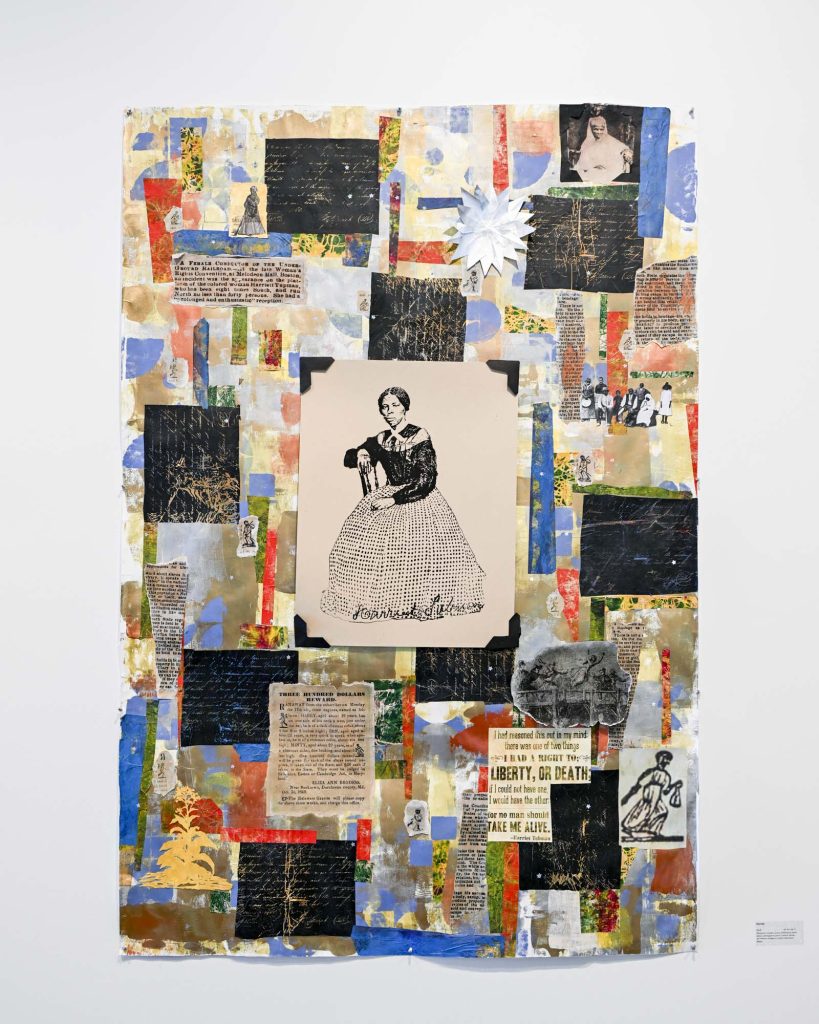
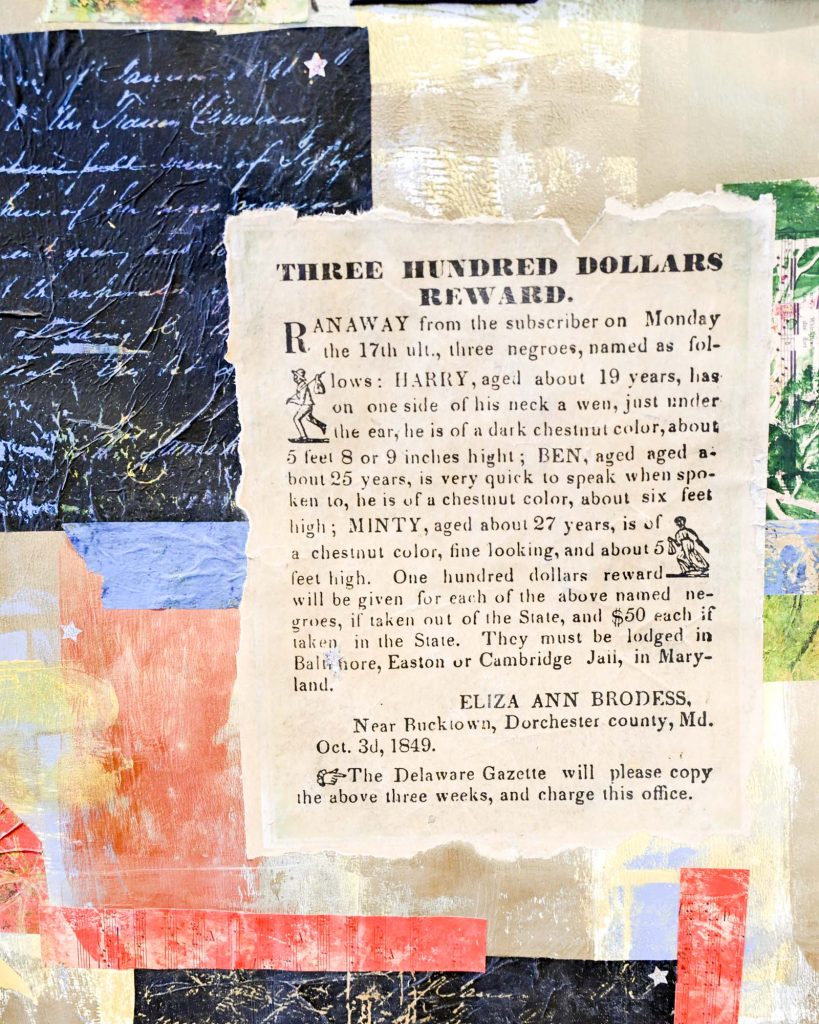
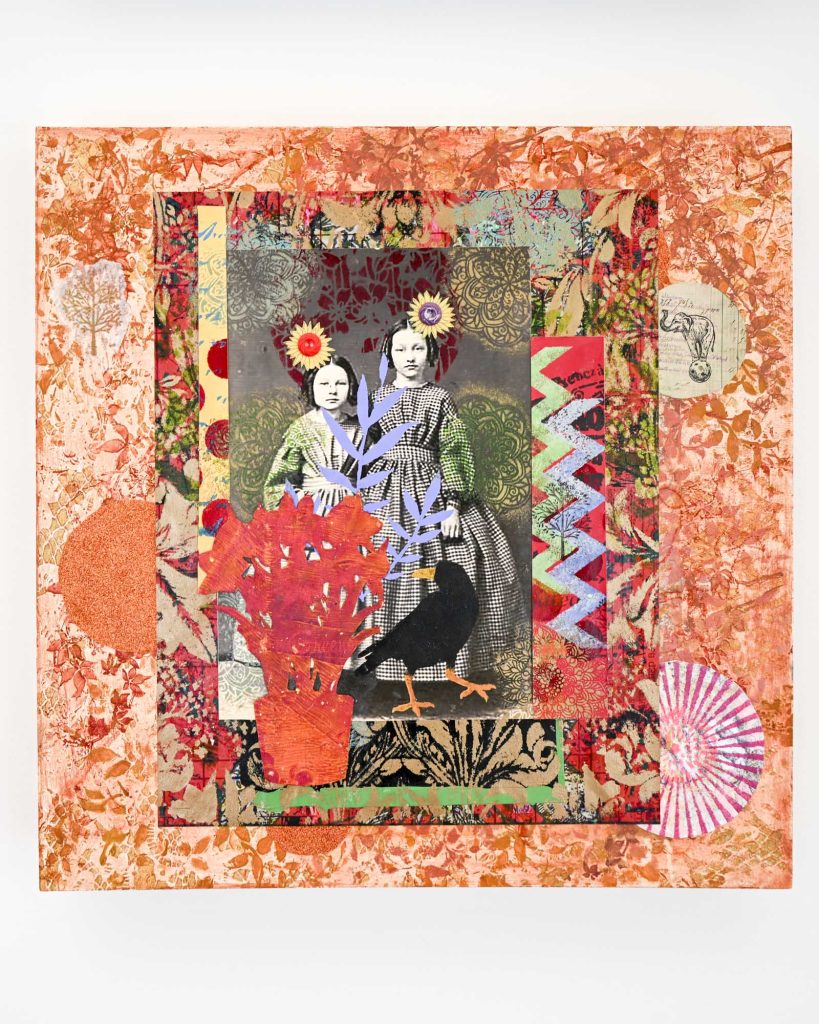
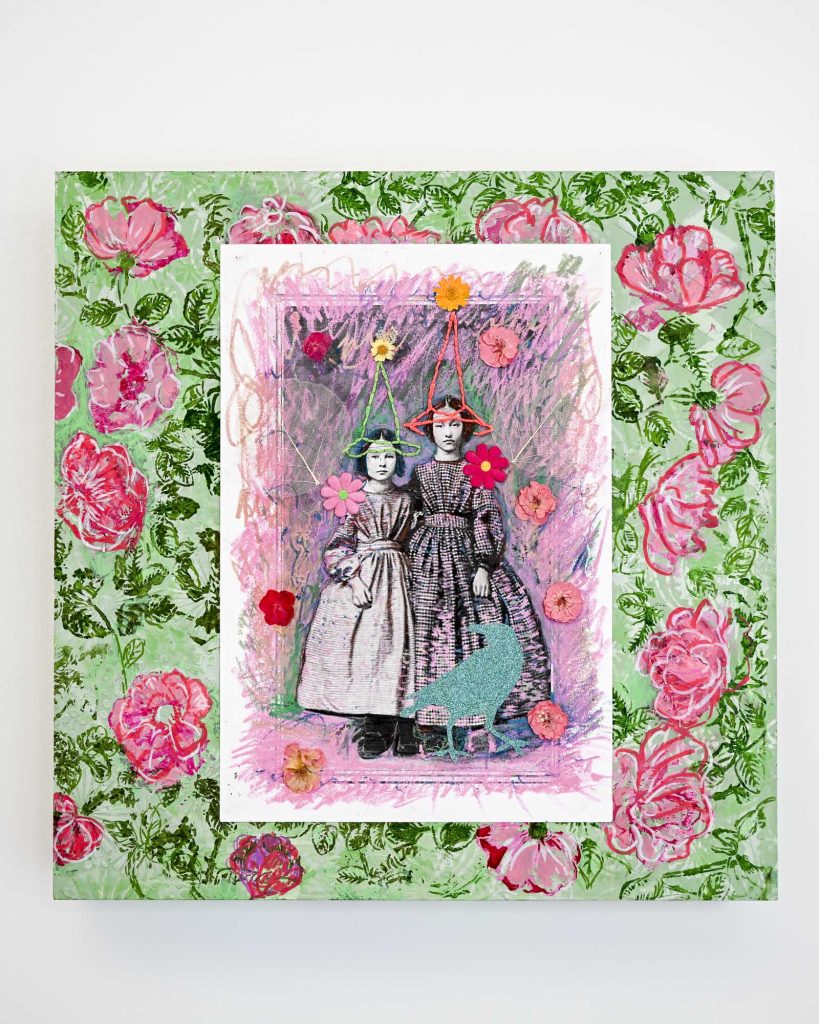
That same impulse to gather recurs elsewhere around a single repeated image. In Les Sœurs (the sisters) and its later companion Les Sœurs, Déconstruites, a Victorian photograph of two girls returns again and again, run through silkscreen and stencil until the pair multiplies across the surface like a refrain. Harriet turns the same instinct toward history, assembling a portrait of Harriet Tubman from period fragments: a reward notice for an escaped enslaved woman and her own words vowing “liberty or death.”
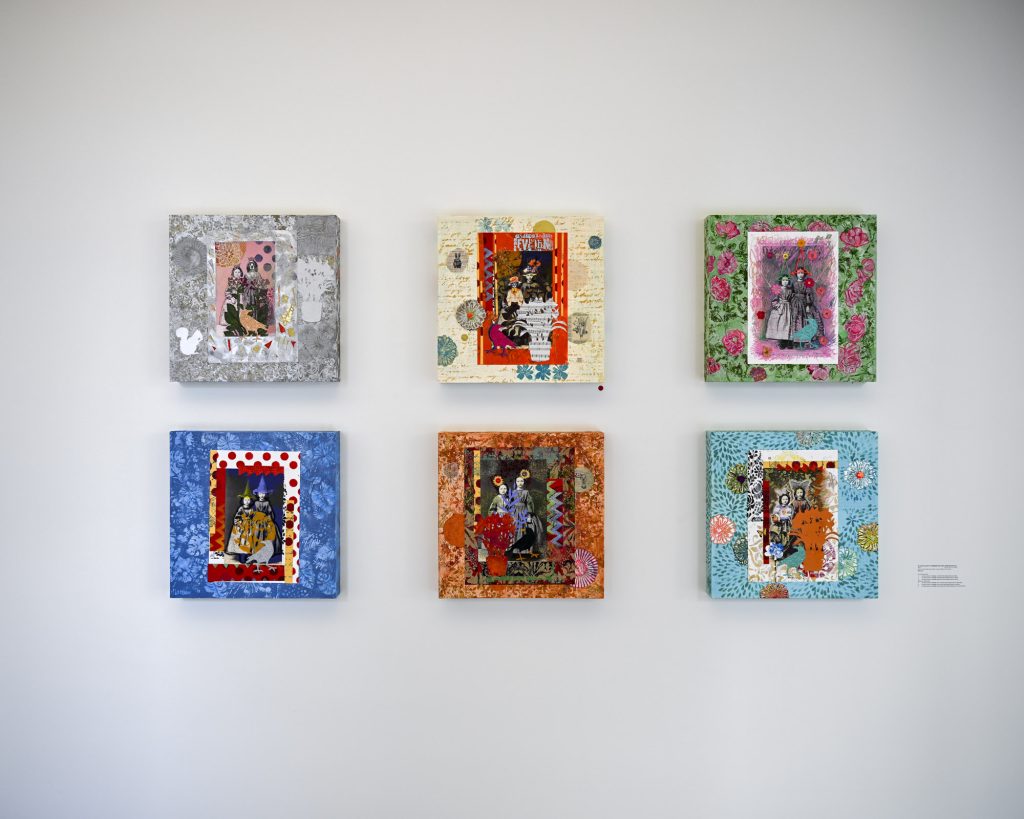
Each of these works succeeds on its own terms. The particularities of the space, however, do little to bring them forward. The difficulty begins with scale: Thirteen works is a modest showing, and, because there are clustered sets — a trio of small floral panels; a grid of six square “dress-up” portraits — the exhibition reads as closer to six encounters than 13. The result leaves one wanting more, which is, in a way, its own kind of praise, though a real issue all the same. Additionally, Gallery 100 occupies a corridor on the mezzanine of a downtown office tower, a program of the architecture firm Page Southerland Page, and, however cleanly it is lit, a hallway remains a hallway. More problematically, several works are pinned to the wall with pushpins that puncture the paper. It is a genuine shame to see work this beautiful, at this scale, seemingly damaged by the very mechanism meant to display it.
None of this, ultimately, is a final measure of the show. The frustrations are worth naming only because the work demands more. Tuttle has been a fixture of Atlanta’s art world for decades, with works held in the collections of The Museum of Contemporary Art of Georgia and Hartsfield-Jackson International Airport — and Paper Quilts and Stories is a reminder of precisely why. She can take inexpensive material and make it hold cosmology, history and memory all at once, on a surface that is genuinely interesting to look at up close. The show is smaller and more casually presented than the work deserves. But it is also, for anyone willing to give it their time, a genuinely rewarding experience to view.
Paper Quilts and Stories by Lisa Tuttle will remain on view at Gallery 100 through September 3.
::

Dr. Kevin M. Storer is a multidisciplinary computing researcher living, working and collecting art in Atlanta. His approach to art criticism and collecting prioritizes the discursive power of artistic practice over purely aesthetic qualities. This perspective is informed by his internationally-awarded scholarship on the complex relationships between people and the objects we create — especially as they shape our identities and social realities. Kevin earned his Ph.D. in informatics from the University of California, Irvine.
STAY UP TO DATE ON ALL THINGS ArtsATL
Subscribe to our free weekly e-newsletter.

