
On memory, nostalgia and the eternal return of childhood: ‘I hope we never Land’ at the Atlanta Fringe Festival
I hope we never Land, a new contemporary dance work by Emma Morris, mines for lost treasure in the green wilds and on the sun-soaked beaches of the choreographer’s self-described “nomadic upbringing.”
She has an academic background in environmental science, and environmentalism is a thematic through line in Morris’ work. “I feel like I spent my entire childhood outdoors, in nature,” Morris told the audience during a lecture demonstration about her project, which will be performed again this Wednesday, Friday and Saturday during the Atlanta Fringe Festival. “I wanted to explore how and why growing up, for me, involved moving indoors, creating a distance between myself and the natural world.”

Springing to life from text that Morris has been writing and re-writing for two years or more, I hope we never Land uses nostalgia like a lure. In the opening solo, performed without music by Fringe Festival veteran Jodie Jernigan, gesture and spoken word evoked the endless days and predictable rhythms of youth. Fire drills beneath an emerald-colored mountain, a blue Mr. Swifty bike and miles cycled before leaving the safety of the house yard, card games of war played by “peanut butter sticky” children in the long summer grass.
With seemingly effortless floor work, Jernigan activated the lower third of the visual plane as the space where memory and the subconscious took on flesh and substance. “I wonder if third grade will ever end,” Jernigan declared as she rested for a few moments on her back and gazed up into the stage lights. “And back around again, back around again, back around again,” she recited as she sank to the floor once more after a brief foray upright, initiating a refrain that echoed and re-echoed throughout the piece.
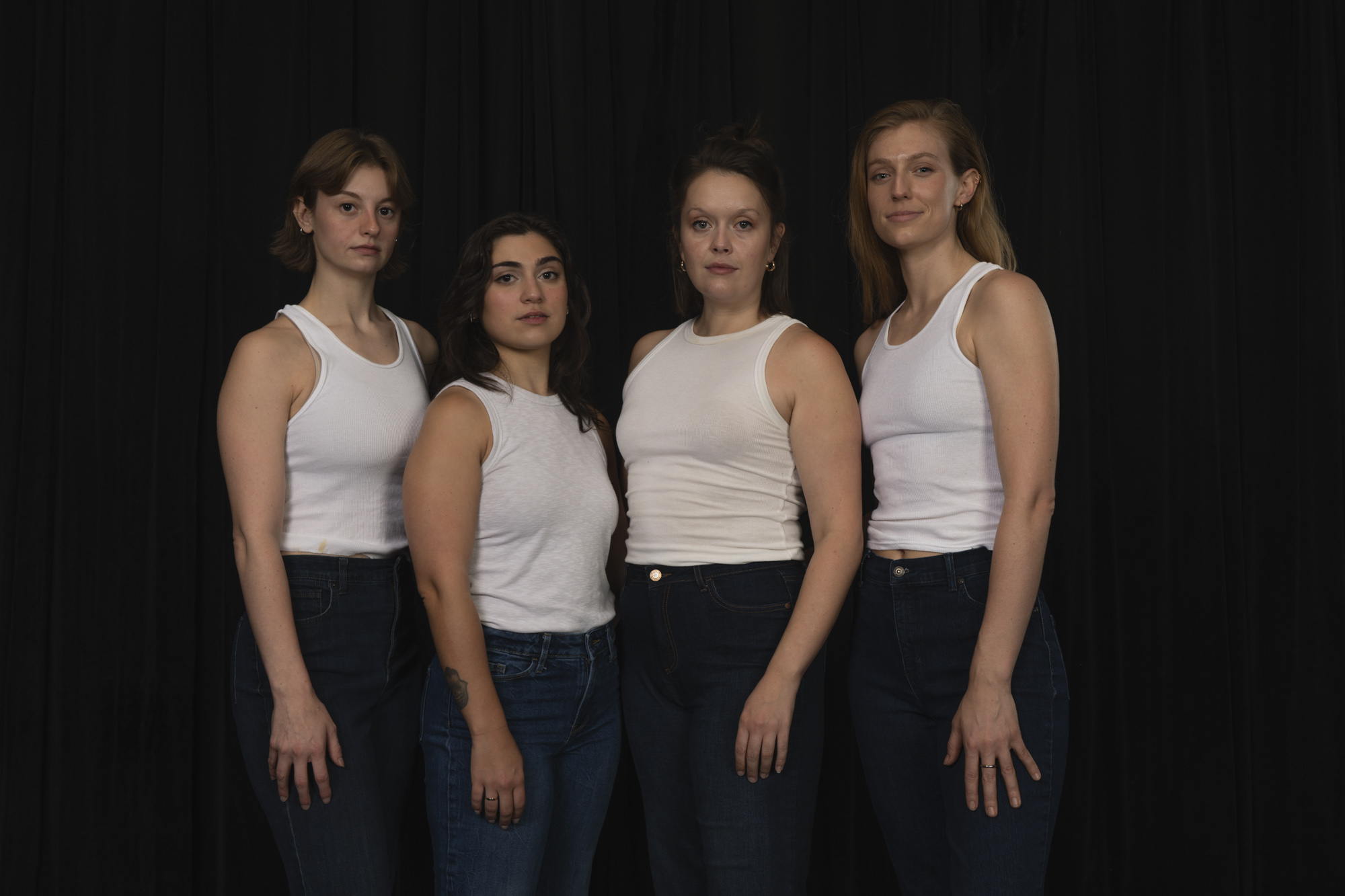
That “back around again” in I hope we never Land seems to be less concerned with returning to the Eden-like idylls of childhood than with reconnecting to a temporality in which past, present and future co-exist in a sort of causality vortex. Each of the four dancers — Jernigan, Morris, Maia Charanis and Meg Gourley (who did not perform in the Sunday, May 31, show observed by ArtsATL) — represents one pair in a set that links past, present and future with memory, reality and dream via something Morris calls the “in between.”
“I think of the work as a circle,” she said, “with my solo [representing the in between] in the middle.” Childhood is the spring of life, she explained, a season that returns over and over in the grand scheme of things, even if not to us as individuals.
Coming at a critical moment in the process for I hope we never Land, a two-week residency at the Hambidge Center offered Morris a brief return to the green world of her childhood. She spent that time adding to and reworking much of the text that the dancers sometimes recite and that has been mixed into the piece’s score. Some of the spoken content also comes from recorded conversations among Morris and the rest of the ensemble about their most persistent childhood memories.
The lecture demonstration that Morris offered with Jernigan’s assistance on Thursday, May 28, was a highlight of the unique programming included during the Atlanta Fringe Festival. While it was helpful as a preview of the work’s thematic and narrative elements, the event also demonstrated that Morris has done a good job crafting a complex, multilayered piece that is clearly accessible to casual theater-goers and dance patrons alike.
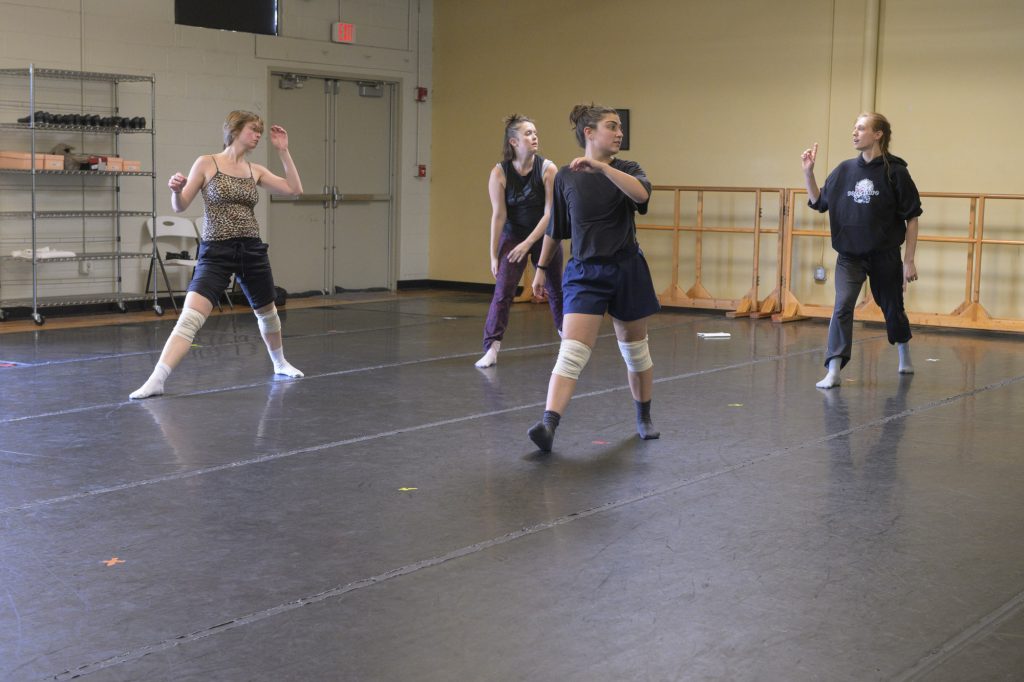
I hope we never Land ventures into the territory of experimental theater while still remaining firmly tethered to its foothold in concert dance. As one of the audience members during the lecture demo expressed it, Morris gives spectators a frame of reference to grab hold of while leaving them room to make their own meaning. Spoken word and referential sonic elements like the winding of a watch create a context against which the meaning of gestural content evolves, without locking in a too-rigid lexicon that would inhibit the aleatory (and pleasurable) meaning-making that comes when mirror neurons fire as we observe others move in new and unexpected patterns.
For example, the past tense narration of childhood imagery in Jernigan’s opening solo followed immediately by a sequence in which all of the dancers iterate through a set piece of phrase work — each dancer according to her own timing, with occasional moments of synchronicity — opens the door to suggestion. The four dancers represent the same persona or concept, yet they are temporally out of phase with one another.
In Morris’ solo, her undulating floor work, coupled with verbal descriptions of lazy-yet-thrilling days testing the boundaries of her endurance against the boundlessness of the ocean, calls to mind images of children and other endangered or lost creatures playing beneath the waves.
“I was never afraid until I had survived,” is another phrase that acquires complexity and shifts in signification as it is repeated throughout I hope we never Land. Ultimately, Morris seems to be asking how treasures mined from the past may transform into debts to the future and how the ways of knowing and being that we learn as children shape the world we make as adults. I hope we never Land returns for a second round of performances this Wednesday through Saturday, June 3 through June 5. For more information and tickets, visit the Atlanta Fringe Festival website.
::

Robin Wharton studied dance at the School of American Ballet and the Pacific Northwest Ballet School. As an undergraduate at Tulane University in New Orleans, she was a member of the Newcomb Dance Company. In addition to a bachelor of arts in English from Tulane, Robin holds a law degree and a Ph.D. in English, both from the University of Georgia.
STAY UP TO DATE ON ALL THINGS ArtsATL
Subscribe to our free weekly e-newsletter.

