
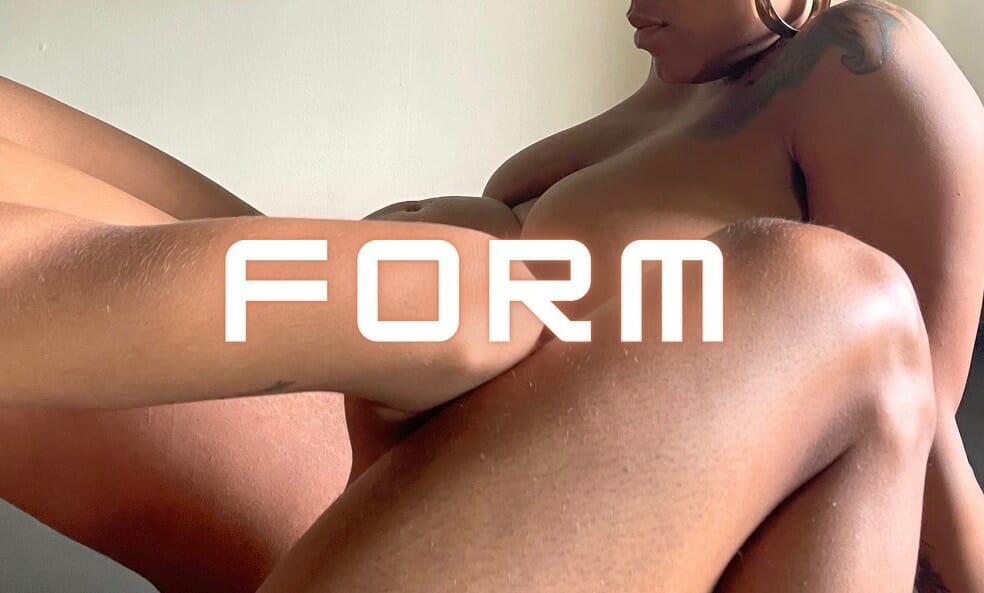
The body in transition is starting point for “Form,” a Black, queer performance
PhaeMonae and Laith Stevenson have been talking about the body in transition. PhaeMonae (she/they), a prolific movement artist who was named “One to Watch” by ArtsATL in 2017, is a former dancer with T. Lang Dance, glo and Core Dance, among others. She recently gave birth to her second child and says she has spent the last three years feeling like her body is “a host for other humans.” Stevenson (she/they), a current resident dance artist at Core Dance, came out as a trans woman a year ago and is undergoing hormone therapy as part of her gender affirmation process.
Last summer the two began documenting their physical transformations as a confidence-building practice. Motherhood, PhaeMonae says, had “infected” too many of her creative outlets, and she felt ready to “debug” herself as an artist. “I really wanted to work on feeling sexy again,” she says.
As part of her artist residency with Fly on a Wall, PhaeMonae presented a movement solo in November that centered self-love in fashion and adornment; a series of starkly lit, mostly nude photographs of herself and Stevenson hung on the walls of the Windmill Arts Center’s White Box. A bold, unapologetic performer and generous collaborator, PhaeMonae began inviting other Black, queer artists into the studio to improvise and discuss shared experiences. Common themes of self-presentation and beauty as well as the affirmation of “Black art as fine art” emerged, and PhaeMonae secured a performance space in Underground Atlanta.
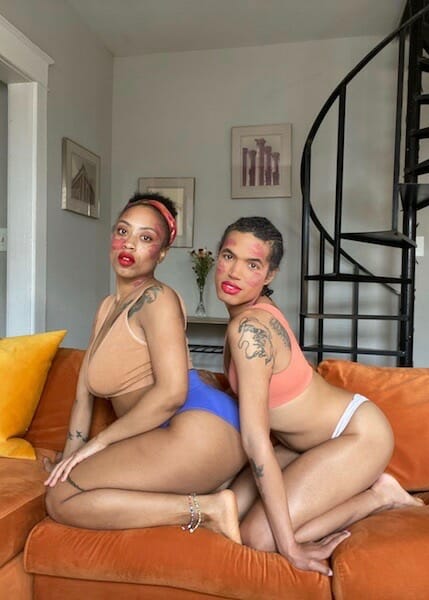
On February 25 and 26, PhaeMonae and Stevenson will join four other artists – choreographers Nicholas Goodly (they/them), Kerri Garrett (she/they), and Okwae Miller (he/him) and hair artist Tiger Hooks (she/her) – to activate three galleries in Underground Atlanta with Form, a Black, queer performance series. (No proof of vaccination or negative Covid test required. Masks highly encouraged inside the galleries.)
Audiences will walk through the gallery spaces and experience each artist’s work “like a domino effect,” one work activating the next, says PhaeMonae.
Goodly, an accomplished filmmaker, writer and poet, will present a looped video that confronts queer presentation and respectability politics as they are experienced in the body.
Garrett will perform live alongside a film, exploring themes of aging and coming into her queerness. Miller’s solo Sanctuary, which will be performed in a smaller basement space, delves into “shedding” both emotional and physical weight after experiencing loss.
“It’s a big celebration around Black queer bodies,” says PhaeMonae. “We’re going to celebrate that we’re here, we’re alive, and we’re working through some shit. We have support and a voice. We can make things that are pretty, and it is fine art.”
In her work for Form, PhaeMonae reclaims her individuality and grapples with a changing relationship to her body as a mother, a dancer and a queer woman. “Because I’m in a heterosexual-presenting relationship, I was feeling a lot of identity dysmorphia, not understanding if I can still claim myself as a queer woman and attach myself to my androgyny,” she says. “Who is the person mothering these children?”
Similarly, Stevenson refers to her body as “a changing entity” and draws a parallel between her gender transition and durational performance practice. “It feels a bit taxing to perform because I’m performing all the time,” she says. And yet, Stevenson — a movement artist who received an ArtsATL Best Dancer nod in 2018 — feels called to timestamp the changes in her physical abilities by tackling the challenge of live performance.
“Nine months ago, I could do 200 push-ups in a day and eight pull-ups. Six months ago, it was maybe half that. Now I can do maybe 30 or 40 push-ups and a single [pull-up].” Her stamina, after months of feminizing hormone therapy, has significantly diminished, her skin glows, and she’s getting used to dancing with developing breasts. “Nine months ago, I would have thrown myself on the floor,” she says, laughing, and adds that she used to have no problem improvising for hours. Now her body demands that she take more care.
To show the dichotomy of hardship and beauty, Stevenson plans to create and contend with a physical obstacle in the space: a hand-made chandelier. “I was thinking about how much work goes into the bureaucratic side of transitioning that people don’t talk about . . . paperwork to change my social security, change my license, my insurance, the court order to change my name, the petition to change my name, the notice of the petition to change my name,” she says.
Referencing recent anti-trans legislation, Stevenson feels motivated to illuminate the daunting, convoluted process by embarking on a crafting project that is completely new to her. Using the growing stacks of paperwork she has amassed during her transition, she will make a papier-mâché chandelier to represent (and reclaim) the red tape.
In her artist bio, Stevenson writes: “Laith asks her audiences to bear witness to the performer/performers enduring an experience, thus deepening the empathetic response.” Performed identity is at the forefront of Stevenson’s recent choreographic explorations. Her work Person(a), which premiered at the Windmill Arts Center in 2019, delved into “our most dramatic truths and how we display them.” Three years and one pandemic later, the six artists of Form find commonality in the process of moving toward their most authentic selves.
::
Kathleen Wessel is a movement artist, choreographer, educator and writer who has been covering dance for ArtsATL since 2012. She is on faculty in the Department of Dance Performance & Choreography at Spelman College.
STAY UP TO DATE ON ALL THINGS ArtsATL
Subscribe to our free weekly e-newsletter.

