
Review: Out Front’s “one in two” coaxes cast and audience out of comfort zones
One in two is the kind of show that many people will avoid because it is uncomfortable, but it is also the kind of show that everyone across America should see. This current production — running through April 1 at Out Front Theatre — is proof positive of that.
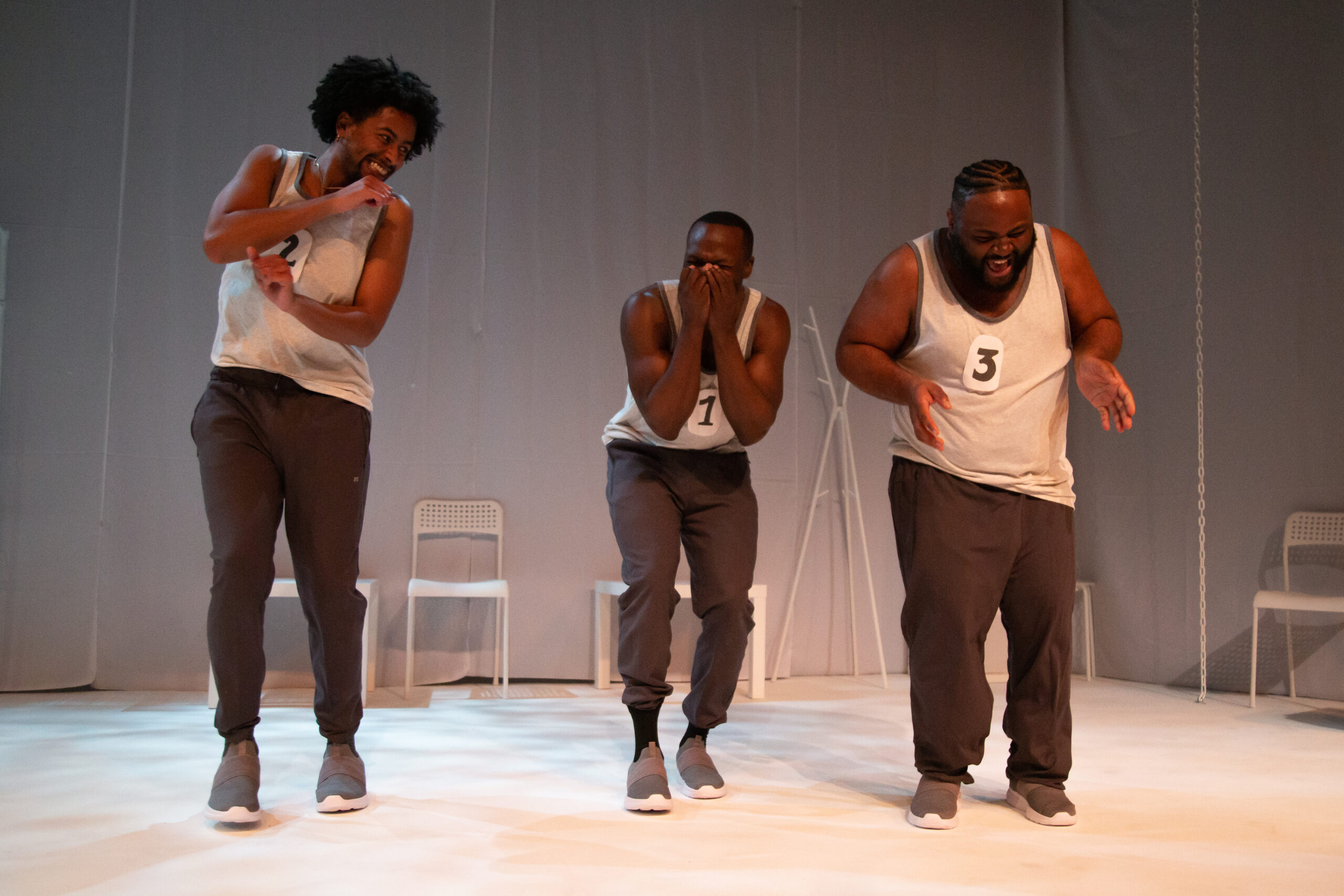
Donja R. Love’s one in two follows three Black, queer men who sit in an ethereal waiting room, waiting to see which one of them will be diagnosed with HIV. Every so often, a random string of numbers will be generated via projection on the back wall, and the men are forced to take a number. The title of the play refers to the statistic produced by the Centers for Disease Control and Prevention — if the current trends persist, one in every two Black queer men will be diagnosed with HIV during his lifetime. While the men wait, they begin to act out a story about a young man named Donte who contracts HIV and begins to spiral into alcoholism and depression.
The script, which was written as a way for Love to process his own HIV diagnosis, contains several references to Love’s own experiences, even implying that Donte is a stand-in for Love. However, as the three men step in and out of the story, we get the impression that they are uncomfortable with the implications of the story they are telling.
The three men are played by Patrick Hamilton, Michael Ward and Robert King Jr. and are differentiated in the script only as “Person on the Left,” “Person in the Middle” and “Person on the Right,” respectively. They are also given numbers at the beginning of the play, with Ward being assigned “Number 1,” meaning that he has to assume the role of Donte. Hamilton becomes “Number 2” and King becomes “Number 3,” meaning that they will portray the various people that Donte interacts with.

By virtue of their roles, Hamilton and King get to showcase a wider range than Ward does, switching from intensity to levity as they morph into nurses, lovers, mothers, support group members, bartenders and a range of other characters. Ward, however, slowly sinks into his character as Donte falls deeper into depression. He has particularly strong chemistry with Hamilton — who may be the most versatile actor out of the bunch — as many of the vignettes have them acting together under a variety of different circumstances.
King has his dramatic moments, but for much of the play, he serves as the comic relief. His natural charm and comedic timing help to introduce some levity even as the play delves head-first into some very grim discussions about how the stigmas around HIV keep Black men isolated and erode their sense of self-worth.
Paul Conroy’s scenic design is simple but effective, especially when combined with Beate M. Czogalla’s lighting design. The pure white landscape of Conroy’s set serves as a blank canvas upon which Czogalla projects a variety of atmospheres. This creates a startling contrast anytime the men step out of Donte’s story, and the stage reverts to the harsh white of the waiting room.
Director J.L. Reed displays a keen understanding of the emotional weight that the play carries, as well as the importance of its subject, and his staging reflects that. The play does not compromise on the inherent darkness of the HIV epidemic (which, as one of the characters so adamantly reminds us, is still an epidemic), but it also thrives on Love’s inherent humor and the charisma of its actors. There are even moments of sensualness that reveal an insatiable longing for connection.
HIV is something that still affects queer communities and people of color at a rampantly disproportionate rate, but Love unabashedly sheds light on just how much damage is wrought at the intersection of those two identities. This production of one in two pulls no punches, nor is it afraid to make people uncomfortable. At its core, it is a hard-hitting piece about the silence, alienation and shame suffered by Black queer men, and it is something that anyone with any interest in the queer community should make a point of going to see.
::
Luke Evans is an Atlanta-based writer, critic and dramaturg. He covers theater for ArtsATL and Broadway World Atlanta and has worked with theaters such as the Alliance, Actor’s Express, Out Front Theatre and Woodstock Arts. He’s a graduate of Oglethorpe University, where he earned his bachelor’s degree, and the University of Houston, where he earned his master’s.
STAY UP TO DATE ON ALL THINGS ArtsATL
Subscribe to our free weekly e-newsletter.

